
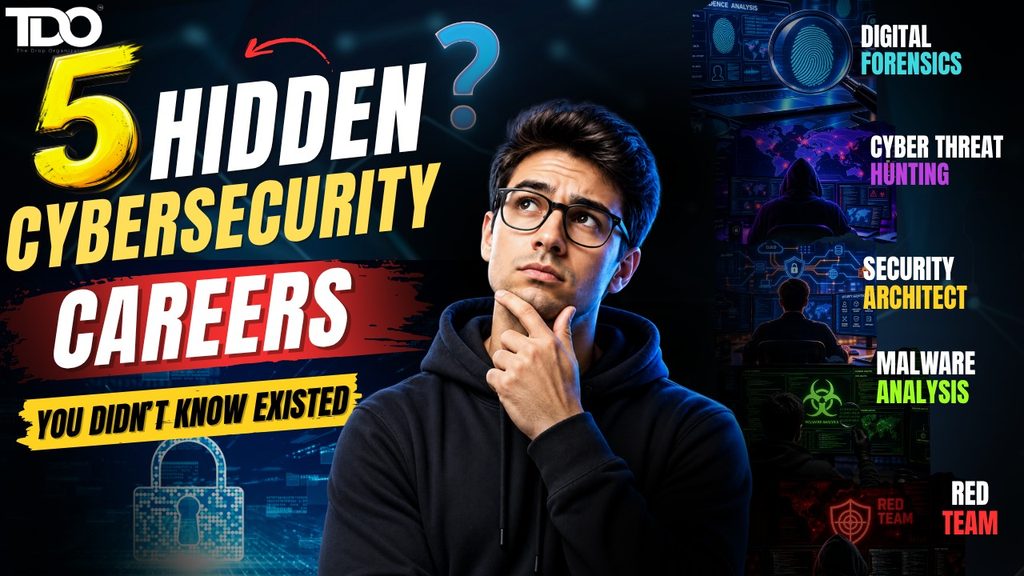
Discover 5 exciting cybersecurity careers beyond ethical hacking, including threat hunting, digital forensics, malware analysis, AI security and risk analysis.
When people hear the words cybersecurity careers, they often imagine a hacker, sitting in a dark room, typing commands on multiple screens, trying to break into a computer system. Of course, movies have popularized that image. But the real cybersecurity industry looks very different—and frankly it is a lot more interesting.
Cybersecurity is no longer simply about penetration testing, antivirus software, or monitoring suspicious network traffic. As businesses migrate to the cloud, artificial intelligence becomes a part of the day-to-day work, digital investigations are getting more complex, and cyberattacks become more financially damaging, organizations require professionals with highly specialized knowledge. This has created an increasing diversity of cybersecurity careers that many students and beginners have never even heard of.
You might be surprised to learn that a person working in security could spend their day investigating digital evidence, hunting for threats that have not yet triggered an alert, analyzing malware, securing artificial intelligence systems or helping organizations understand the financial consequences of a cyberattack.
And that is exactly what makes this field so exciting.
If you are thinking about a career in ethical hacking, information security or technology, do not restrict yourself to the job titles you already know. There’s a much bigger world than the classic “ethical hacker” or “security analyst” role. In this guide, we’ll be looking at 5 cybersecurity careers that need much more attention.
We’ll look at what these professionals do, the skills they need, who can get into these fields and how you can start preparing for them.
Also Read:- The Human Firewall: Why Strong Cybersecurity Starts with You in 2026?
Why Are There So Many Cybersecurity Careers Today?
Before diving into these lesser-known roles, it helps to understand why the cybersecurity job market is so varied. Think about how organizations work today. The company might have websites, mobile apps, cloud infrastructure, remote employees, AI tools, customer databases, payment systems, IoT devices, and hundreds or thousands of employee accounts.
Each of these technologies has a potential security responsibility. You can’t have one security team doing everything the same way anymore. Organizations need specialists with knowledge of specific technologies, attack methods, regulations, investigations, and business risks. That’s why the modern cybersecurity careers go far beyond traditional security operations.
Some experts halt attacks. Others study them. Some look for hidden attackers inside networks. Others reverse-engineer malicious software, or help companies understand what went wrong after an incident. There are also jobs that blend cybersecurity with law, psychology, artificial intelligence, finance, and business management.
It means that building a cybersecurity career doesn’t necessarily mean you have to be a person who likes to sit in front of a terminal all day. Your existing interests can actually help you find your niche. Modern cybersecurity careers go far beyond traditional security operations.
1. Cyber Threat Hunter: The Job That Tracks Down Hackers Before They Are Found
Suppose a burglar has entered a building but the alarm system has not yet been activated. A traditional security system might wait for an alarm. A threat hunter does something different. They move through the building, looking for anyone who looks out of place. That’s what a cyber threat hunter really does.
Threat hunting is one of the most interesting aspects of modern cybersecurity as it involves pro-actively searching for attackers, suspicious behavior and indicators of compromise within an organization’s environment.
Instead of waiting for a security alert to pop up, threat hunters ask questions such as: “Could an attacker already be inside the network?” “Is there unusual activity that our automated detection systems have missed?” “Does this behavior match a known attack technique?”
This makes threat hunting one of the more investigative careers in cyber security out there today.
What is a Threat Hunter?
As a threat hunter, you usually have to deal with huge volumes of security data. This may include endpoint activity, authentication logs, network traffic, cloud activity, DNS requests, process information and security alerts. They look for signals that bad things are happening.
For example, let’s say an employee normally logs in from Kolkata during business hours. Suddenly the account starts authenticating from another country at 3:00 AM, accesses unusual resources, and starts downloading massive amounts of data.
Then a threat hunter would investigate if this is compromised credentials, legitimate travel, automated activity, or something more serious. Curiosity is needed for the work, because often there is no simple “correct answer” at the beginning of an investigation.
Skills that can help you get started in threat hunting:
- Basics of networking
- SIEM platforms
- Endpoint Detection & Response (EDR)
- Intelligence on threats
- Logs analysis
- MITER ATT&CK knowledge
- Automation & Scripting
- Analytical mindset
- Incident response
Threat hunting can be particularly rewarding for students who like to solve puzzles, explore unusual behavior, and understand how attackers operate.
2. Digital Forensics Investigator: Solving Crimes With Digital Evidence
Have you ever watched a crime investigation show where investigators use fingerprints, CCTV footage, and physical evidence to piece together what happened? Now imagine doing something similar, but with computers, smartphones, servers, cloud accounts and digital storage.
Welcome to digital forensics.
A digital forensics investigator looks at electronic evidence to determine what happened in a security incident or investigation. They could look at hacked computers, stolen data, suspicious files, deleted information, unauthorized access, or other types of digital activity. This is one of the most unique cybersecurity careers for professionals as it is a mix of technology and investigation and evidence analysis.
What Does Digital Forensics Involve?
Consider an organization that learns confidential documents were copied from an employee’s computer. The investigator cannot just assume that the employee stole them. Instead, they have to look at the evidence that is available. What dates were the files accessed? What account was used? Was a USB device attached? Were files compressed or copied? Were there any suspicious programs running? Did the data transfer over the network? Were files deleted afterward?
Digital forensic investigators use specialized techniques to answer such questions. They may examine disk images, file systems, metadata, system logs, browser history, memory captures, email records and other digital evidence.
The investigator also must be very careful in collecting evidence and following proper procedures. In the legal process, the credibility of the evidence, and the integrity of the evidence, can be as important as the technical discovery itself.
Who Might Consider This Career?
Digital forensics could be a good fit if you enjoy:
- Investigative work
- Finding hidden information
- Analyzing evidence
- Computer systems
- Attention to detail
- Cybercrime investigations
- Problem-solving
You do not necessarily have to be the person who hacks a system. You may be the one who will reconstruct precisely what happened next.The distinction is what makes digital forensics one of the most interesting cybersecurity careers for those who prefer investigation to offensive security work.
3. Malware Analyst: Decoding the Code of Cyber Attacks
Now imagine that you receive a suspicious file. Someone says it may have malware in it. Your job is to figure out what it does. It does not steal passwords. Yes, it encrypts files. Does it talk to a command and control server? Is it downloading yet another malware? Trying to hide?
That’s where malware analysts come into play. Malware analysis is the study of malicious software to understand its behavior, actions, capabilities, and potential impact. This is one of many cybersecurity careers that may be especially appealing to students who enjoy programming, reverse engineering, and learning how software works internally.
What is a Malware Analyst?
Malware analysts might receive suspicious executables, scripts, documents, mobile apps or other files. Their job is to keep them safe by analyzing those samples in controlled environments.
They may start with static analysis , in which they inspect the file without executing it . They can see strings, metadata, imported functions, file structure, hashes and other attributes. Then there’s dynamic analysis, where you actually run the sample in an isolated lab environment and see what it actually does. For example, analysts might determine that a suspicious program:
- Creates a new process.
- Modifies a registry key.
- Attempts to establish persistence.
- Connects to a remote server.
- Downloads another payload.
- Attempts to collect credentials.
These behaviors help security teams create detections and protect other systems.
What Should You Know?
Malware analysis might require a more technical background than some entry level security positions. Useful areas include:
- Programming fundamentals
- Python
- C/C++ basics
- Assembly language
- Operating systems
- Reverse engineering
- Networking
- Debugging
- Windows internals
- Linux fundamentals
You don’t have to be perfect at everything right away. First, learn how software works. Then transition gradually into reverse engineering and malware analysis through legal training environments and malware-analysis labs. If you love asking “What is this program really doing?” then this could be one of those cybersecurity careers worth exploring.
4. Security Architect – The Person Who Builds Security Into The Systems
Most people only think about cybersecurity after they’ve built the system. This is something the security architect does before the system is built. A company is about to launch a major cloud platform. It requires databases, applications, employee access, customer authentication, APIs, network connectivity, monitoring, encryption and backup systems. Somebody needs to take a step back, and ask: “So how do we design this system so that security is built in by design?”
That’s what the Security Architect is for. Security architecture is one of the most unique modern cybersecurity careers because it requires both technical and strategic thinking. A security architect doesn’t look for individual vulnerabilities. They consider designing the environment as a whole to reduce risk.
What is a Security Architect?
Security architects may design or review security controls for networks, applications, cloud infrastructure, identity systems, endpoints and data environments.They might be concerned with ideas like:
- Zero Trust architecture
- Network segmentation
- Identity and Access Management
- Encryption
- Cloud security
- Secure application design
- Security monitoring
- Disaster recovery
- Security policies
- Risk management
Say you have an organization that wants remote access for employees to internal applications. A security architect is going to have to think more than just throwing up a login page. How do users sign in? Is multi-factor authentication mandatory? Which applications each employee can access? How will the devices be evaluated? How will suspicious activity be determined? What if your account is compromised? How to safeguard sensitive information? These decisions can affect the whole organization.
Who is Suited for this Career?
Security architecture is best suited for those who enjoy figuring out how different technologies connect. You need strong technical foundations but you also need communication and decision-making skills because architects work with developers, network engineers, cloud teams, management and security professionals a lot. Good things to learn are:
- Networking
- Cloud platforms
- IAM
- Application security
- Encryption
- Risk assessment
- Secure architecture
- Zero Trust
- Security frameworks
This isn’t generally the initial position you accept after you’ve completed a beginners course. It frequently develops after having experience in other tech or security roles. But understanding early what a security architect does can help you plan your career long-term. For students who like to build systems rather than just attack them, security architecture can be one of the most rewarding cybersecurity careers to pursue.
5. Red Team Operator – Think Like an Attacker
Finally we reach the role most likely to be closest to the image most people have of cybersecurity. The Red Team. But there is a huge difference between a red team operator and someone just trying to hack a system. A professional red team is one with authorization and a clear purpose. They are supposed to mimic real-world attacks against an organization so that defenders can spot weaknesses before actual attackers do.
Simply put, they think like attackers to develop a more resilient organization. This makes red teaming one of the most exciting cybersecurity careers for those who like offensive security.
What does a Red Team Operator do?
Red team engagement is an authorized simulation of a real-world attack that may include reconnaissance, research on vulnerabilities, social engineering, network penetration testing, application testing, credential attacks, privilege escalation, lateral movement, and other techniques. The goal is not simply to “break into anything.”
A professional red team says: How could an attacker realistically get in there? What security controls would pick up the activity? Was the attacker able to hop from system to system? What sensitive resources could be accessed? How soon would the defenders realize? What should the organization do differently? That’s why red team operations often include working closely with the blue team, which is responsible for defending the environment.
Skills Needed for Red Teaming
A red team operator requires a wide technical base, because real-world attacks hardly ever depend on a single vulnerability. Useful knowledge includes:
- Networking
- Linux and Windows
- Active Directory
- Web application security
- Cloud security
- Scripting
- Penetration testing
- Social engineering awareness
- Privilege escalation concepts
- Threat actor techniques
Certifications can help later, but hands-on experience is extremely important. Build a legal home lab, practice on intentionally vulnerable systems, participate in CTFs, learn how to professionally document your findings. If you enjoy thinking ahead and asking yourself “What would an attacker try next?” then red teaming could be a great direction. And among the many cybersecurity careers, it’s certainly one of the paths that can turn curiosity into hands-on offensive-security expertise.
Which One of These Careers Is Right for You?

After reading about these five cybersecurity careers you may be asking yourself which role you should select. The answer is less about what sounds impressive, and more about the type of problems you actually enjoy solving.
If you like examining evidence and piecing together what happened, Digital Forensics might be your path. If you like research, intelligence gathering and understanding threat actors then check out Threat Intelligence. If you like to think strategically about security and design systems, consider becoming a Security Architect. If programming, reverse engineering, and understanding malicious code fascinate you, Malware Analysis could be a strong fit. And if you like offensive security and thinking like an attacker, Red Teaming could be the path you have been looking for.
The key thing is these are not boxes in isolation. Professionals often change specialties in the course of a career. The next step a penetration tester can take is red teaming. A threat intelligence analyst might move to a SOC. An incident responder might specialize in digital forensics. A network engineer can transition to a security architect. That flexibility is one of the biggest advantages of being involved in cybersecurity careers.
How Can Students Get Ready for These Careers?
You do not have to be an expert in all of the five fields by graduation. Indeed, trying to learn it all at once can leave you feeling overwhelmed. Build a good foundation instead and then move on to each specialization with small practical projects. Begin with Networking, Linux, Windows, Programming and Basic Security Concepts. Once you’re comfortable with those fundamentals, play around in different areas. For example, you might:
- Analyze a packet capture to understand network activity.
- Investigate a simulated forensic image.
- Research a recent threat campaign.
- Build a secure network architecture in a lab.
- Analyze a harmless malware sample in an isolated environment.
- Perform a penetration test against an intentionally vulnerable machine.
The goal is not to be an expert right away. The aim is to find out what sparks your curiosity to continue learning. That curiosity is one of the greatest assets you can bring to your cybersecurity careers.
What Skills Should You Have Before You Pursue These Careers?
Whatever path you take, the first thing you need to do is build a solid cybersecurity foundation before approaching your cybersecurity careers. Begin with networking. Know IP addresses, ports, DNS, HTTP/HTTPS, VPNs, firewalls, routing and common protocols. Then learn about operating systems, specifically Linux and Windows.
Programming is a valuable skill as well. Python can assist with automation, log analysis, security scripts and data processing. You should also understand:
- Authentication and authorization
- Encryption and hashing
- Vulnerability management
- Malware fundamentals
- Incident response
- Security monitoring
- Cloud security
- Identity and access management
- Basic ethical hacking
The industry data reinforces the importance of specialized skills. ISC2 reported that 41% of respondents cited AI as a top skill need, followed by 36% for cloud security, 29% for risk assessment, and 28% for application security. Yet technical knowledge is not everything. But it’s not all about technical knowledge.
The same study also found that problem-solving, collaboration, communication, willingness to learn, and strategic thinking were some of the most important non-technical skills to hiring managers. So along with learning the cybersecurity tools, don’t forget to learn how to explain what you found.
How The Drop Organization Can Help You Start Your Cybersecurity Journey?
If you are a student reading this and thinking, “These cybersecurity careers sound exciting, but where do I actually start?” This is where structured practical learning can make a difference. At The Drop Organization (TDO), we are all about getting learners from just reading about cybersecurity to actually understanding it.
TDO offers ethical hacking and cybersecurity programs like DCSC – Drop Certified Security Course and The Hack Track (THT) with training in ethical hacking, penetration testing, network security, Linux, web application security and other hands-on cybersecurity concepts. The method of The Drop Organization is quite useful for students who are interested in cybersecurity careers because the basic principles of ethical hacking can be the springboard for a number of the specializations discussed in this article.
For example, learning networking, Linux, web security, vulnerability assessment, OSINT, and penetration testing can give a learner a foundation from which to later explore red teaming, threat intelligence, digital forensics, malware analysis, or security architecture.
TDO also stresses hands-on learning, with practical labs, live demonstrations and career guidance included in their published course information rather than just focusing on theory. Currently, the organization’s website lists two cybersecurity offerings – DCSC and The Hack Track. DCSC is described as a program that includes advanced penetration testing, exploit development, network security, digital forensics, and threat analysis.
That doesn’t mean you’re automatically a digital forensics investigator, malware analyst, or security architect. These are specialized cybersecurity careers that demand more experience and continuous learning. Instead, think about the practical training as the bedrock of the journey. You learn the basics, you try different things, you figure out what you like, and then you focus intentionally. And that’s exactly how you should look at cybersecurity careers.
The Future of Cybersecurity is Niche
The cybersecurity industry is evolving fast and the numbers tell the story. ISC2 cites that 73% of respondents believe AI will create more specialized cybersecurity skills, and 72% believe it will create a need for more strategic cybersecurity mindsets. The research also found that 87% believe that there will always be a need for cybersecurity professionals.
At the same time the threat environment is changing. Verizon’s 2025 DBIR found ransomware in 44% of the breaches it covered, with vulnerability exploitation up 34% as an initial access vector. These trends result in an important outcome: Cybersecurity is not getting any easier. It’s getting more specialized. Organizations will need professionals who can investigate evidence, understand threats, design secure systems, analyze malicious code, test defenses, secure cloud infrastructure, and respond to new technologies. That means students entering the field have more options than ever.
Final Thoughts: Your Ideal Cybersecurity Career May Be the One You Have Never Heard Of
When students first become interested in cybersecurity, they usually search for familiar job titles. Ethical hacker. Penetration tester. Security analyst. SOC analyst. Those are excellent career paths, but they are only the beginning. The world of cybersecurity careers is much larger. Digital Forensics Investigators reconstruct incidents using digital evidence. Threat Intelligence Analysts study attackers and emerging campaigns. Security Architects design secure systems before vulnerabilities become problems. Malware Analysts study malicious software to understand how attacks work. Red Team Operators simulate real-world attackers to find vulnerabilities before criminals can exploit them.
And these five roles are a drop in the ocean of what’s out there. The most important thing is not to choose a job because it sounds impressive. Choose it because you like the problem it poses for you to solve. If you’re into investigation, check out digital forensics. If you love research, get into threat intelligence. If you like designing systems, try security architecture. If you have a passion for code and reverse engineering, then try malware analysis. If you love thinking like an attacker, check out red teaming.
And if you’re still not sure, that’s all right. Learn the basics. Start out. Try other parts. Build real-world projects. Take part in legitimate cybersecurity labs. Learn from experienced professionals. Use training platforms such as The Drop Organization to strengthen your foundation, and then gradually identify the specialization that keeps you curious. Because the best career is not always the one you discover first. Sometimes, it is the one you didn’t even know existed. Ask yourself something more useful:
- Do I enjoy investigating?
- Do I enjoy researching threats?
- Do I enjoy designing systems?
- Do I enjoy understanding code?
Your answers could point you toward the right specialization. And that is perhaps the most exciting thing about cybersecurity careers: you do not have to fit the stereotypical image of a hacker to build a successful future in cybersecurity. You simply need to find the problem you enjoy solving—and then become exceptionally good at solving it.
What are the best cybersecurity careers for beginners?
The good news is that you don’t have to start your journey by trying to become a “master hacker.” Beginners can explore roles such as SOC analyst, security analyst, penetration tester, junior threat intelligence analyst, or digital forensics trainee. Once you understand what part of cybersecurity excites you, you can gradually move toward specialized roles such as malware analysis, red teaming, or security architecture.
Is cybersecurity a good career in 2026?
Absolutely. Cybersecurity has evolved from being a specialized IT function into a major business requirement. As organizations adopt cloud computing, AI, remote work, and connected technologies, they also need professionals who can protect them. The exciting part is that you are not limited to one career path—you can choose from technical, investigative, strategic, and offensive-security roles.
Do I need programming skills for cybersecurity careers?
You don’t need to be a programming expert to enter every cybersecurity role. However, learning programming—especially Python—can make your cybersecurity toolkit much stronger. It can help you automate repetitive tasks, analyze information, create security tools, and understand how applications work. For specialized areas such as malware analysis, deeper programming knowledge becomes even more valuable.
Are cybersecurity certifications enough to get a job?
Certifications can certainly strengthen your profile, but think of them as proof that you studied something—not proof that you can do everything. Employers also value practical experience. Build labs, complete security projects, participate in CTFs, document your findings, and create a portfolio that demonstrates how you apply what you have learned.
Can students start learning cybersecurity before graduation?
Definitely—and starting early can actually give you a significant advantage. You don’t have to wait until graduation to begin. Start with networking, Linux, Windows, programming, and basic security concepts, then experiment with CTFs, virtual labs, and intentionally vulnerable systems. The goal isn’t to know everything immediately; it is to keep building one skill on top of another.
Stay Connected With TDO
Want to start your learning journey on Cyber Security and Ethical Hacking field?

2 Responses