
How to Start a Cybersecurity Career With No Experience: 7 Powerful Steps to Get Your First Job in 2026

Learn how to start a cybersecurity career with no experience through 7 powerful steps covering skills, projects, certifications, networking, and job preparation. Imagine yourself looking at a job portal for cybersecurity jobs and you see requirements like networking knowledge, Linux, SIEM tools, penetration testing, cloud security, certifications and previous experience all under the same job description. If you’re a student, recent graduate, career switcher or transitioning from a completely different field, it’s common to look at these requirements and think, “How am I supposed to get experience when every job is asking for experience?” It’s one of the biggest questions that people have when they begin looking at a cybersecurity career. The good news is, when you’re starting a cybersecurity career with no experience, you’re not starting out with zero value. Before you land your first cybersecurity job, you can build knowledge, practical skills, projects, certifications and a professional portfolio, and these give employers something tangible to evaluate. Cybersecurity is also much more than ethical hacking itself. A cybersecurity career can take you in a direction such as security operations, penetration testing, vulnerability assessment, cloud security, application security, digital forensics, governance and compliance, threat intelligence, incident response, security engineering, and many more. The industry is also changing rapidly. In ISC2’s 2026 research 95% of respondents said their organizations had at least one cybersecurity skills needed and 59% characterized the skills deficiency as critical or significant. The same research also points to increasing needs in fields like AI, cloud security, application security, risk assessment and GRC. That doesn’t mean you’ll get your first job on auto-pilot. That means you have a good reason not to just rack up certificates and hope recruiters find you but to develop relevant cybersecurity skills. So, if you’re wondering how to start a cybersecurity career with no experience, this guide will take you through seven practical steps. Also Read:- What Are Phishing Attacks? 7 Dangerous Phishing Attacks You Must Know in 2026 Step 1: Understand Cybersecurity and Choose Your Career Path One of the first mistakes that newbies make is to try to learn everything about cyber security at once. You open YouTube and see ethical hacking, Kali Linux, penetration testing, malware analysis, digital forensics, cloud security, bug bounty hunting, SOC operations, OSINT, cryptography, networking and dozens of cybersecurity tools. You have watched videos on all of them after a couple of days, but you can’t confidently do any practical task. This can lead to a confusing cybersecurity career journey. Instead, first, understand what the cybersecurity industry actually consists of and then pick a direction that interests you in the cybersecurity career journey. For example, someone who likes to investigate suspicious activity might explore a SOC analyst pathway, while someone who likes to find vulnerabilities in applications might explore penetration testing or application security. If you’re interested in business processes, you may be better suited to a role in GRC, risk management or compliance. Some of the most popular cybersecurity career paths are: You don’t have to make a lifetime career decision on day one. Your first goal is just to pick a direction for your first learning. This is especially important for beginners in cyber security because different roles require different combinations of knowledge. A penetration tester needs hands-on testing skills, while a GRC professional may spend a lot more time working with policies, controls, risk and compliance requirements. A useful question to ask yourself is: “What sort of cybersecurity problem would I actually enjoy fixing?” Having an answer makes it much easier to build your cybersecurity career. Step 2: Build Your IT, Networking and Linux Fundamentals Tools alone won’t give you a strong cybersecurity career. Knowing Nmap can scan a network is good, but knowing why a port is open, what a service is doing, how TCP/IP works and what happens when a device communicates across a network is far more useful. Hence, a beginner must spend some time understanding some basic concepts related to IT and computer networking before learning advanced hacking techniques. Start with topics such as: Linux deserves special attention as it is often found in secure computing environments, particularly in penetration testing, security operations, cloud environments and security labs. You don’t have to be a Linux admin before you apply for your first cyber security job. But you should be comfortable with navigating the command line, managing files and permissions, understanding processes, installing packages and using basic networking commands. Same with Windows. Cybersecurity professionals often work in Windows endpoints, Active Directory environments, event logs, authentication systems and enterprise applications. That foundation might not sound as sexy as releasing a pen-testing tool, but that is what allows you to know what the tool is actually doing. Thus, tools are for performing cybersecurity work, but fundamentals are for understanding the results. That distinction can make a huge difference throughout your cybersecurity career. Step 3: Learn Basic Concepts and Tools of Cybersecurity As your IT foundation grows, start learning the concepts that build the foundation of cybersecurity career. Start with the CIA Triad—confidentiality, integrity and availability—and gradually move into authentication, authorization, access control, encryption, vulnerabilities, malware, phishing, social engineering, endpoint security, network security, incident response and security monitoring. You’ll also want to learn about common cybersecurity frameworks and concepts such as vulnerability management, risk assessment, least privilege, defense in depth, and zero trust. Next, begin by using cybersecurity tools. Depending on your chosen path, useful tools may include: The important word here is controlled. If you are learning ethical hacking, only practice on systems you own or have explicit permission to test. You can legally develop your practical skills through virtual machines, cybersecurity labs, CTF platforms and deliberately vulnerable applications . This is where ethical hacking proves particularly helpful for those entering cybersecurity career journey. Ethical hacking teaches you to think about how vulnerabilities can be found and exploited so that organizations can understand and address those weaknesses. Ethical hacking, however, should be seen as a part of cybersecurity, and not all
5 Powerful Cybersecurity Careers You Didn’t Know Existed in 2026
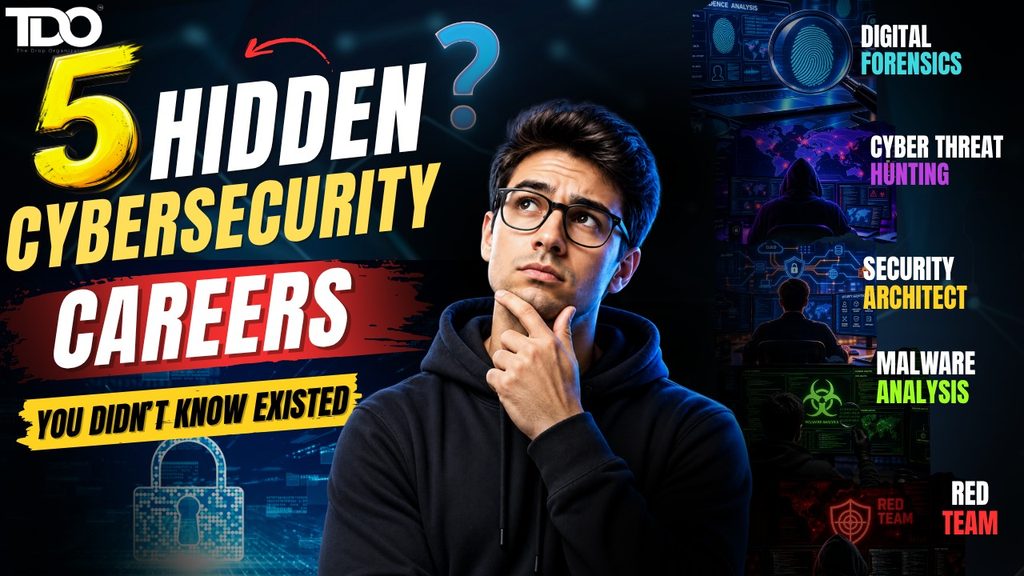
Discover 5 exciting cybersecurity careers beyond ethical hacking, including threat hunting, digital forensics, malware analysis, AI security and risk analysis. When people hear the words cybersecurity careers, they often imagine a hacker, sitting in a dark room, typing commands on multiple screens, trying to break into a computer system. Of course, movies have popularized that image. But the real cybersecurity industry looks very different—and frankly it is a lot more interesting. Cybersecurity is no longer simply about penetration testing, antivirus software, or monitoring suspicious network traffic. As businesses migrate to the cloud, artificial intelligence becomes a part of the day-to-day work, digital investigations are getting more complex, and cyberattacks become more financially damaging, organizations require professionals with highly specialized knowledge. This has created an increasing diversity of cybersecurity careers that many students and beginners have never even heard of. You might be surprised to learn that a person working in security could spend their day investigating digital evidence, hunting for threats that have not yet triggered an alert, analyzing malware, securing artificial intelligence systems or helping organizations understand the financial consequences of a cyberattack. And that is exactly what makes this field so exciting. If you are thinking about a career in ethical hacking, information security or technology, do not restrict yourself to the job titles you already know. There’s a much bigger world than the classic “ethical hacker” or “security analyst” role. In this guide, we’ll be looking at 5 cybersecurity careers that need much more attention. We’ll look at what these professionals do, the skills they need, who can get into these fields and how you can start preparing for them. Also Read:- The Human Firewall: Why Strong Cybersecurity Starts with You in 2026? Why Are There So Many Cybersecurity Careers Today? Before diving into these lesser-known roles, it helps to understand why the cybersecurity job market is so varied. Think about how organizations work today. The company might have websites, mobile apps, cloud infrastructure, remote employees, AI tools, customer databases, payment systems, IoT devices, and hundreds or thousands of employee accounts. Each of these technologies has a potential security responsibility. You can’t have one security team doing everything the same way anymore. Organizations need specialists with knowledge of specific technologies, attack methods, regulations, investigations, and business risks. That’s why the modern cybersecurity careers go far beyond traditional security operations. Some experts halt attacks. Others study them. Some look for hidden attackers inside networks. Others reverse-engineer malicious software, or help companies understand what went wrong after an incident. There are also jobs that blend cybersecurity with law, psychology, artificial intelligence, finance, and business management. It means that building a cybersecurity career doesn’t necessarily mean you have to be a person who likes to sit in front of a terminal all day. Your existing interests can actually help you find your niche. Modern cybersecurity careers go far beyond traditional security operations. 1. Cyber Threat Hunter: The Job That Tracks Down Hackers Before They Are Found Suppose a burglar has entered a building but the alarm system has not yet been activated. A traditional security system might wait for an alarm. A threat hunter does something different. They move through the building, looking for anyone who looks out of place. That’s what a cyber threat hunter really does. Threat hunting is one of the most interesting aspects of modern cybersecurity as it involves pro-actively searching for attackers, suspicious behavior and indicators of compromise within an organization’s environment. Instead of waiting for a security alert to pop up, threat hunters ask questions such as: “Could an attacker already be inside the network?” “Is there unusual activity that our automated detection systems have missed?” “Does this behavior match a known attack technique?” This makes threat hunting one of the more investigative careers in cyber security out there today. What is a Threat Hunter? As a threat hunter, you usually have to deal with huge volumes of security data. This may include endpoint activity, authentication logs, network traffic, cloud activity, DNS requests, process information and security alerts. They look for signals that bad things are happening. For example, let’s say an employee normally logs in from Kolkata during business hours. Suddenly the account starts authenticating from another country at 3:00 AM, accesses unusual resources, and starts downloading massive amounts of data. Then a threat hunter would investigate if this is compromised credentials, legitimate travel, automated activity, or something more serious. Curiosity is needed for the work, because often there is no simple “correct answer” at the beginning of an investigation. Skills that can help you get started in threat hunting: Threat hunting can be particularly rewarding for students who like to solve puzzles, explore unusual behavior, and understand how attackers operate. 2. Digital Forensics Investigator: Solving Crimes With Digital Evidence Have you ever watched a crime investigation show where investigators use fingerprints, CCTV footage, and physical evidence to piece together what happened? Now imagine doing something similar, but with computers, smartphones, servers, cloud accounts and digital storage. Welcome to digital forensics. A digital forensics investigator looks at electronic evidence to determine what happened in a security incident or investigation. They could look at hacked computers, stolen data, suspicious files, deleted information, unauthorized access, or other types of digital activity. This is one of the most unique cybersecurity careers for professionals as it is a mix of technology and investigation and evidence analysis. What Does Digital Forensics Involve? Consider an organization that learns confidential documents were copied from an employee’s computer. The investigator cannot just assume that the employee stole them. Instead, they have to look at the evidence that is available. What dates were the files accessed? What account was used? Was a USB device attached? Were files compressed or copied? Were there any suspicious programs running? Did the data transfer over the network? Were files deleted afterward? Digital forensic investigators use specialized techniques to answer such questions. They may examine disk images, file systems, metadata, system logs, browser history, memory captures, email records
Cybersecurity for Students: Why Learning Digital Security Is No Longer Optional in 2026

Cybersecurity for students is becoming an essential skill in 2026. Discover why digital security matters, the risks students face online, career opportunities in cybersecurity, and how courses like DCSC and THT from The Drop Organization (TDO) can help build a secure future. Ten years ago, cybersecurity for students was often seen as a niche domain for IT professionals, government agencies and big corporations. Most students focused on traditional subjects and thought cybersecurity was the domain of experts behind computer screens in large organizations. Fast forward to 2026, and the reality is completely different. Students now spend much of their lives online. The internet has become a part of student life – attending virtual classes, submitting assignments, managing social media profiles, online banking, digital payments and even building personal brands. Technology has created countless opportunities but also serious risks. Cybercriminals are no longer just targeting large organizations. Students are one of the fastest growing targets because they often have valuable personal information but lack enough cybersecurity awareness. And that’s exactly why cybersecurity for students has become one of the most important topics in modern education. Digital security is no longer an option for techies, it’s a life skill. In the digital world of today, every student must understand how cyber threats work, how personal information can be stolen, and how online attacks can impact academic and professional futures. The question is no longer whether students should learn cybersecurity. The real question is: Can they afford not to? Also Read:- AI in Cyber Attacks: How Artificial Intelligence Is Powering the Next Generation of Cyber Threats in 2026 The Digital Lives of Today’s Students Think about the normal day of a student.The day often starts by checking notifications on a smartphone. Students use email accounts, educational portals, cloud storage, social media, instant messaging, digital payment apps and online learning systems during the day. Each of these digital activities leaves a footprint online. Every account has valuable information like personal details, academic records, contact information, financial information, passwords, photos and videos and social connections as well. This data is an opportunity for cybercriminals. Many students are wrong in believing that hackers only attack the rich or the big guys. In reality attackers often go for the low-hanging fruit and students are often victimized because of weak passwords, unsafe browsing habits and lack of cybersecurity for students awareness. This increasing danger makes cybersecurity for students more relevant than ever before. Why Are Students Now the Prime Targets of Cybercriminals? Cybercriminals understand that students are highly active online and often less cautious than experienced professionals. There are a number of reasons why students are attractive targets: These risks are a critical part of cybersecurity for students, and it helps individuals make safer decisions online. Common Cyber Threats Students Face Every Day One of the reasons cybersecurity for students is so important is because of the vast range of cyber threats in everyday life. These threats are why cybersecurity for students should be part of everyday digital life. The Price of Poor Digital Security Many students are not aware of the consequences of cyber attacks. At first glance, a hacked account may seem like a minor inconvenience, but the effects can linger. The possible consequences are: What happens if you work on an academic project for months and then lose access to cloud storage when your account is hacked? Or think of what hacking a social media account can do to internship openings and professional relationships. These risks demonstrate why investing time in cybersecurity for students is an investment in future success. Cybersecurity Skills Students Must Know Students should also learn cybersecurity skills, just as they learn math, communication and problem-solving skills. These are the basic skills which make up the foundation of effective cybersecurity for students. Why Is Cybersecurity Emerging As a Career Opportunity? Besides personal protection, cybersecurity for students has become one of the fastest growing industries globally. Organizations are facing a growing threat from cyber attacks and require skilled professionals to safeguard their digital assets. This makes careers in cybersecurity highly sought after. Popular roles include: Ethical Hacker, Penetration Tester, Security Analyst, SOC Analyst, Cybersecurity Consultant, Incident Response Specialist, Vulnerability Assessor, and many more. For students exploring career options, cybersecurity offers: This makes cybersecurity for students relevant not only for protection of self, but also for career development. The Rise of Ethical Hacking and Cybersecurity Education Educational institutions and training organizations are expanding cybersecurity for students programs as cyber threats increase. Ethical hacking is one of the most exciting career tracks for students interested in technology and security. Ethical hackers employ the same techniques as hackers but use these techniques for defensive purposes. They seek to: Students learn ethical hacking, how attacks happen and how organizations can defend themselves. How The Drop Organization (TDO) Is Empowering Future Cybersecurity Professionals? The Drop Organization (TDO) has established itself as a leading platform for cybersecurity education and skill development. Recognizing the growing importance of cybersecurity for students, TDO provides practical, industry-focused training programs designed to prepare learners for real-world challenges. DCSC: Drop Certified Security Course – A Flexible Start to Your Cybersecurity Journey One of the biggest challenges that students face while choosing a cybersecurity course is the affordability. Many learners want to develop cybersecurity skills but are hesitant because of large upfront fees. Keeping this challenge in mind, The Drop Organization (TDO) has re-engineered the DCSC (Drop Certified Security Course) as a flexible learning model that allows students to embark on their cybersecurity journey based on their budget and learning goals. Unlike conventional cybersecurity courses that follow a one-size-fits-all structure, DCSC offers multiple tiers of learning where students can upgrade their learning experience in a gradual manner as per their progress. DCSC Starter Plan – Rs. 2,500 The Starter Plan is great for beginners who want to get their feet wet in cybersecurity before committing to a larger investment. Students are awarded: This plan is perfect for students who are new to cybersecurity and want