
5 Powerful Cybersecurity Careers You Didn’t Know Existed in 2026
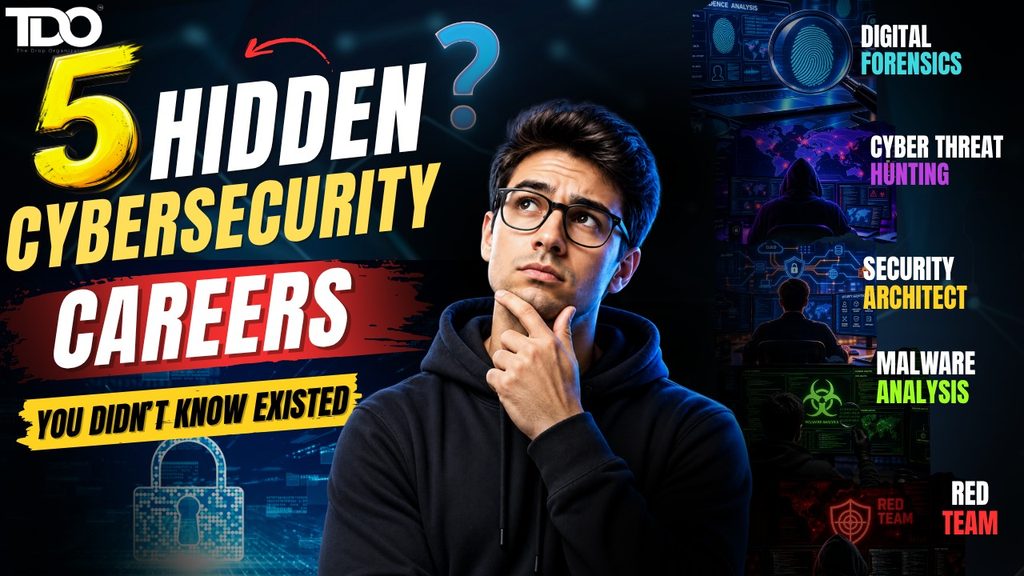
Discover 5 exciting cybersecurity careers beyond ethical hacking, including threat hunting, digital forensics, malware analysis, AI security and risk analysis. When people hear the words cybersecurity careers, they often imagine a hacker, sitting in a dark room, typing commands on multiple screens, trying to break into a computer system. Of course, movies have popularized that image. But the real cybersecurity industry looks very different—and frankly it is a lot more interesting. Cybersecurity is no longer simply about penetration testing, antivirus software, or monitoring suspicious network traffic. As businesses migrate to the cloud, artificial intelligence becomes a part of the day-to-day work, digital investigations are getting more complex, and cyberattacks become more financially damaging, organizations require professionals with highly specialized knowledge. This has created an increasing diversity of cybersecurity careers that many students and beginners have never even heard of. You might be surprised to learn that a person working in security could spend their day investigating digital evidence, hunting for threats that have not yet triggered an alert, analyzing malware, securing artificial intelligence systems or helping organizations understand the financial consequences of a cyberattack. And that is exactly what makes this field so exciting. If you are thinking about a career in ethical hacking, information security or technology, do not restrict yourself to the job titles you already know. There’s a much bigger world than the classic “ethical hacker” or “security analyst” role. In this guide, we’ll be looking at 5 cybersecurity careers that need much more attention. We’ll look at what these professionals do, the skills they need, who can get into these fields and how you can start preparing for them. Also Read:- The Human Firewall: Why Strong Cybersecurity Starts with You in 2026? Why Are There So Many Cybersecurity Careers Today? Before diving into these lesser-known roles, it helps to understand why the cybersecurity job market is so varied. Think about how organizations work today. The company might have websites, mobile apps, cloud infrastructure, remote employees, AI tools, customer databases, payment systems, IoT devices, and hundreds or thousands of employee accounts. Each of these technologies has a potential security responsibility. You can’t have one security team doing everything the same way anymore. Organizations need specialists with knowledge of specific technologies, attack methods, regulations, investigations, and business risks. That’s why the modern cybersecurity careers go far beyond traditional security operations. Some experts halt attacks. Others study them. Some look for hidden attackers inside networks. Others reverse-engineer malicious software, or help companies understand what went wrong after an incident. There are also jobs that blend cybersecurity with law, psychology, artificial intelligence, finance, and business management. It means that building a cybersecurity career doesn’t necessarily mean you have to be a person who likes to sit in front of a terminal all day. Your existing interests can actually help you find your niche. Modern cybersecurity careers go far beyond traditional security operations. 1. Cyber Threat Hunter: The Job That Tracks Down Hackers Before They Are Found Suppose a burglar has entered a building but the alarm system has not yet been activated. A traditional security system might wait for an alarm. A threat hunter does something different. They move through the building, looking for anyone who looks out of place. That’s what a cyber threat hunter really does. Threat hunting is one of the most interesting aspects of modern cybersecurity as it involves pro-actively searching for attackers, suspicious behavior and indicators of compromise within an organization’s environment. Instead of waiting for a security alert to pop up, threat hunters ask questions such as: “Could an attacker already be inside the network?” “Is there unusual activity that our automated detection systems have missed?” “Does this behavior match a known attack technique?” This makes threat hunting one of the more investigative careers in cyber security out there today. What is a Threat Hunter? As a threat hunter, you usually have to deal with huge volumes of security data. This may include endpoint activity, authentication logs, network traffic, cloud activity, DNS requests, process information and security alerts. They look for signals that bad things are happening. For example, let’s say an employee normally logs in from Kolkata during business hours. Suddenly the account starts authenticating from another country at 3:00 AM, accesses unusual resources, and starts downloading massive amounts of data. Then a threat hunter would investigate if this is compromised credentials, legitimate travel, automated activity, or something more serious. Curiosity is needed for the work, because often there is no simple “correct answer” at the beginning of an investigation. Skills that can help you get started in threat hunting: Threat hunting can be particularly rewarding for students who like to solve puzzles, explore unusual behavior, and understand how attackers operate. 2. Digital Forensics Investigator: Solving Crimes With Digital Evidence Have you ever watched a crime investigation show where investigators use fingerprints, CCTV footage, and physical evidence to piece together what happened? Now imagine doing something similar, but with computers, smartphones, servers, cloud accounts and digital storage. Welcome to digital forensics. A digital forensics investigator looks at electronic evidence to determine what happened in a security incident or investigation. They could look at hacked computers, stolen data, suspicious files, deleted information, unauthorized access, or other types of digital activity. This is one of the most unique cybersecurity careers for professionals as it is a mix of technology and investigation and evidence analysis. What Does Digital Forensics Involve? Consider an organization that learns confidential documents were copied from an employee’s computer. The investigator cannot just assume that the employee stole them. Instead, they have to look at the evidence that is available. What dates were the files accessed? What account was used? Was a USB device attached? Were files compressed or copied? Were there any suspicious programs running? Did the data transfer over the network? Were files deleted afterward? Digital forensic investigators use specialized techniques to answer such questions. They may examine disk images, file systems, metadata, system logs, browser history, memory captures, email records