
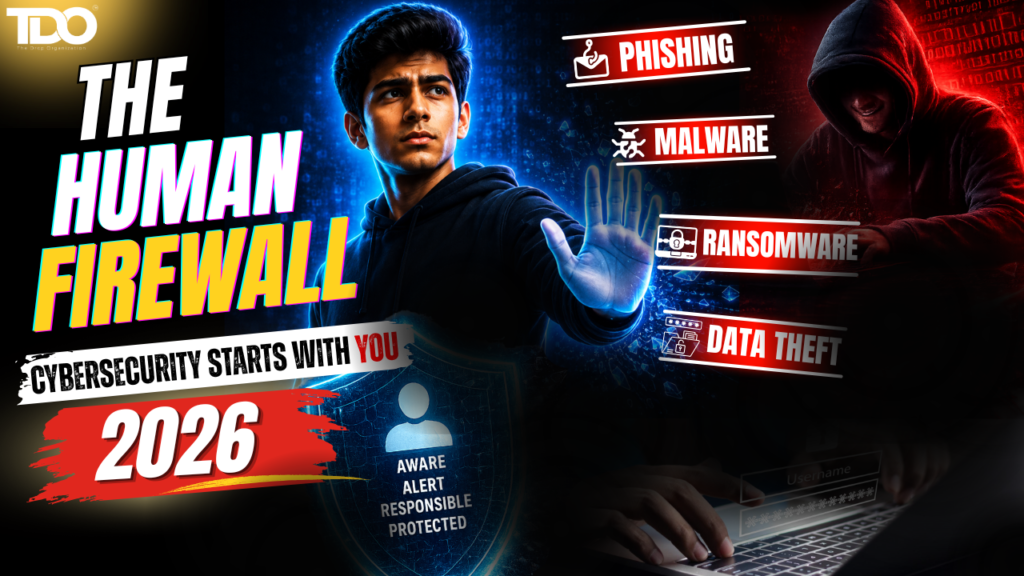
Discover why the human firewall is the strongest defense against cyber threats. Learn how cybersecurity awareness, smart online habits, and digital responsibility can protect you and your organization from modern cyber attacks.
Imagine entering a building secured by biometric scanners, CCTV cameras, security guards and high tech alarm systems. “Every entry is watched, every visitor is checked, every step is noted. It’s almost impossible for an intruder to gain access, on the face of it.
Now picture a stranger approaches an employee outside the building and says, “I forgot my access card. Please hold the door for me, okay?” The employee smiles and opens the door, wanting to be helpful.
All of these costly security precautions come to nothing in a matter of seconds – not because the technology failed but because a person made an innocent decision. This is one of the simplest examples of why the concept of a human firewall has become one of the most significant discussions in contemporary cybersecurity. When most people think of cybersecurity they think of antivirus software, firewalls, encryption or advanced hacking tools. These technologies are important, but they often miss one important fact: The user of the security system is typically the strongest or weakest link in any security system.
Every day hackers do millions of attacks across the world. Surprisingly, many of them don’t start off by attacking computers. Instead they go after people. They send believable emails, bogus job offers, fraudulent payment requests and real looking login pages. Not because software is feeble but because human behaviour is often easier to manipulate.
That’s why organizations across the globe are investing not only in technology, but also in building a human firewall. It’s not software – a human firewall. A person with the awareness, knowledge and confidence to identify online dangers before they become security incidents. Cybersecurity doesn’t begin at the computer in today’s digital world. It starts with you.
Also Read:- 4 Cybercrime Psychology Secrets: Why People Get Hacked?
What Is a Human Firewall?
The human firewall is a term used to describe people who are actively protecting themselves and their organization by making smart decisions around cybersecurity. A human firewall acts like a traditional firewall filtering bad network traffic, but filters bad email, bad links, unexpected calls and strange online activities before they do damage. Let’s put it this way.
Technology can stop many known attacks. But technology can’t always tell you whether to trust a message claiming to be from your bank. It cannot tell if an email asking for an urgent payment is genuine. Sometimes it does not know when someone is trying to play on your emotions. Enter the human firewall.
One important question can help a smart employee, student or web user to prevent an attack:
“This looks legit?” That one moment of awareness can sometimes thwart financial fraud, identity theft, ransomware infections, or data breaches.
Why Cybersecurity Isn’t Just About Technology Anymore?
For many years, cybersecurity was almost entirely focused on technical defenses. Companies bought antivirus software. Firewalls installed. Configured intrusion detection systems. Encrypted sensitive information. These measures are still important, but cybercriminals have evolved.
Instead of attacking the technology directly, they began attacking the people using it. Think about investing millions to protect your company’s servers, only to have an employee unknowingly distribute login credentials with a phony email. The technology worked perfectly.
The attack worked because of how people behave. That is precisely why the concept of the human firewall has grown more and more significant. Today’s cybersecurity professionals know that it’s not enough to protect computers. People must also understand how cyber attacks work.
They need to know. They need to think critically. But most importantly, they need confidence to question suspicious situations.
Why Humans Are the First Line of Defense?
Cybersecurity is often mistakenly viewed as an IT department responsibility. In fact, anyone who uses a smartphone, laptop, email account or social media is part of an organization’s cybersecurity strategy. Every employee, every student, every teacher, every business owner, every internet user, every choice they make builds up a feeling of safety or exposure.
A good human firewall can spot the warning signs before clicking on a suspicious attachment. They check for unexpected requests. They make good passwords. They support Multi Factor Authentication. They report unusual activity rather than ignoring it. In most cases, these simple actions will stop attacks before cybersecurity software is ever involved.
This is why more and more experts are talking about people as the first, and often most important, line of defense.
The Costliest Cybersecurity Mistake Isn’t Technical
Suppose you posed the question: “What is the greatest cyber security threat today?” Most people would say: Malware, Ransomware, Hackers, Viruses, Artificial Intelligence. These are all serious threats, but cybersecurity reports keep pointing to another issue: A human error.
Clicking the wrong link, sharing confidential information, using weak passwords, not paying attention to software updates, accessing open WiFi., downloading apps from unknown sources. Each one of these seemingly small choices can open the door for attackers. This is not to say people are careless. It just means people are busy. We’re distracted. We’re curious. We’re emotional.
Most people don’t realize how well cybercriminals understand these behaviors. That’s why building a human firewall is no longer optional. It’s becoming a necessity.
Hackers Don’t Hack Computers First- They Hack People
One of the greatest myths regarding cybersecurity is that hackers spend all their time writing complex code. In reality, many successful cyber-attacks start with a simple chat. A fake email. A scam phone call. A convincing LinkedIn message. A QR code placed in a public location. A social media advertisement.
Each attack is carefully crafted around human psychology. Attackers know people trust known brands. They know students react quickly to internship opportunities. They know that employees fear the loss of access to company accounts. They know that panic breeds urgency, Cybercriminals often try to convince people to bypass security software, not try to beat it. And that’s why the human firewall is so important. Technology detects malware. People will see weird behavior. When they work together, cybersecurity becomes significantly stronger.
Every Click is a Security Choice
Consider how many decisions you make online every day. Opening emails, downloading PDFs, QR code scanning, logging in to websites, connecting to public Wi-Fi, accepting friend requests, installing mobile applications and many more. For many of us, these moves never come to mind as cybersecurity decisions. But each has the potential to either strengthen or weaken digital security.
A strong human firewall learns to stop and think. Instead of reacting immediately they ask:
- Is this sender genuine?
- Why am I receiving this message?
- Does this website look authentic?
- Was I expecting this attachment?
- Could someone be trying to manipulate me?
These simple questions often prevent serious cyber incidents.
Cybersecurity Awareness Is Becoming a Life Skill
Reflect on how many hours a day you’re online. You’re checking e-mail, watching videos, and doing online shopping, and using digital payments, uploading documents, participating in online meetings, and sharing photographs. Every digital interaction offers opportunities for both convenience and cyber risk. Just as people learn traffic rules before they drive a vehicle, digital citizens need to learn cybersecurity before they are able to use the internet confidently. This is why the human firewall concept extends far beyond workplaces. Parents teach kids about internet safety and so that schools are teaching students about cyber security too.
Universities discuss ethical hacking and digital privacy whereas businesses promote safe online behavior. Cybersecurity is becoming a life skill. The bigger our collective human firewall, the safer our digital society is.
Why Phishing Attacks Still Succeed?
Organizations spend millions of dollars each year to bolster their cybersecurity infrastructure. Firewalls get smarter. Antivirus software speeds up. Artificial Intelligence detects suspicious behavior. But phishing attacks are still effective. Why is that? Because phishing is not directly hacking computers.
Imagine receiving an email that looks exactly like a message from your university. The logo is correct. The colors match. The language sounds professional.
The email says: “Your examination portal password will expire today. Please log in immediately.”
You click on the link, not thinking much of it, and enter in your credentials. Everything seemed real. Unfortunately the site was not real. That’s where a human firewall comes in. A trained person doesn’t react immediately. They check the sender’s email address. They look at the website URL. They ask themselves if the request makes sense. And that brief pause can be enough to halt a cyberattack.
Social Engineering: Hacking Tricks Without Programming
When we think of cybercriminals, we often think of people who do complex programming and technical hacking. Many successful attackers don’t need to be expert programmers. They’re wise to human behavior, that’s all. This is called social engineering.
Social engineering is the art of getting people to give away sensitive information willingly. Rather than cracking passwords, attackers lure victims into giving them up. They don’t bypass security systems; they manipulate employees to open the door themselves. A good human firewall questions every unexpected message. Because they are not always attacked by cyber criminals. Sometimes they just ask.
The Everyday Habits That Strengthen a Human Firewall
The good news is that you don’t need a lot of technical know-how to be a human firewall. It starts with little habits done consistently. Think about your health. Now think about cybersecurity. One brushing isn’t going to give you healthy teeth for a lifetime. Likewise, looking at one suspicious email is not a sure way to remain safe in the digital world. Cybersecurity is a habit. It’s a consistent habit. Among the most effective habits are:
- Thinking before clicking unfamiliar links.
- Verifying unknown email senders.
- Creating unique passwords for different accounts.
- Using Multi-Factor Authentication (MFA).
- Keeping software updated.
- Avoiding public Wi-Fi for sensitive transactions.
- Downloading applications only from trusted sources.
- Reporting suspicious messages immediately.
These habits may sound basic, but together they form an effective human firewall that can stop many cyber attacks before they start.
Human Error Is Still the Biggest Cybersecurity Challenge
When there is a major cyber attack, people tend to assume the breach is caused by sophisticated malwares. But surprisingly, investigations often find a much simpler explanation. Someone got the wrong email. Someone told me something in confidence. A security warning was ignored by someone. Someone used the same password for several websites. Technology did what it was designed to do. This opportunity was created by human action.
This doesn’t mean people are being careless. It’s a good reminder that everyone makes mistakes. The goal of a human firewall isn’t to be perfect. It is awareness.
Awareness reduces errors. The more you know the better you choose. Awareness safeguards organizations.
Cybersecurity Is Not Fear—It’s Confidence
A lot of the awareness programming is very fear based. “Don’t click this. “Don’t put that on.” “Don’t trust anyone.” It’s important to be careful, but fear isn’t a productive way to build cybersecurity. It’s based on trust. A confident human firewall knows how to check information.
They know the usual cyber dangers. They can detect phishing emails. They challenge strange requests. Instead of getting anxious every time they get an email, they know exactly what warning signs to look out for. Confidence takes cybersecurity from scary to relevant.
Individuals Begin the Culture of Cybersecurity
Now imagine two organizations. The first spends millions on sophisticated security technology, but does not train employees. The second focuses on building technology and cybersecurity literacy. Which group is more safe?
Most cybersecurity pros would go with the second. Security cannot be created by technology alone. Security is created by people. A single well trained employee can halt an attack before costly security software even picks up suspicious activity.
That’s the reason why organizations are increasingly enabling each employee to be a human firewall, rather than just depending on IT departments. And cybersecurity is much better when everyone pitches in.
Organizations Are Now Investing in People More Than Ever
A few years ago, cybersecurity budgets were all about technology. For many organizations, much of today’s security investment is in knowledge training. Why, sir? Because the research is consistent that a large number of successful cyber attacks start with human interaction not technical vulnerabilities. Companies now conduct:
- Phishing simulation exercises
- Cybersecurity awareness workshops
- Password security training
- Social engineering demonstrations
- Incident response drills
- Secure browsing awareness sessions
The objective of these programs is to make every employee a strong and reliable human firewall. One of the greatest advantages attackers have is when an organization creates thousands of informed employees. The bad guys aren’t finding easy victims, they’re finding people who can spot suspicious behavior.
Artificial Intelligence Has Changed Cybersecurity—But Not Human Accountability
Artificial Intelligence has transformed cybersecurity in amazing ways. Security software is now able to detect unusual activity on networks. Email systems flag suspicious messages automatically. Machine learning algorithms can handle millions of events a second. And yet, for all such advances, artificial intelligence is unable to replace human judgment. Imagine receiving a phone call from someone pretending to be your manager. The caller knows your name. They understand your workplace. They sound convincing.
Even if technology later identifies the conversation as unusual network activity, your decision has already been affected. This is where the human firewall is irreplaceable. Technology can help with decision making. People make them. As AI gets better, cyber criminals will use AI to make scams more believable such as Deepfake videos, voice calls with AI, customized phishing emails and many more. These attacks make the human firewall role all the more important. The future belongs to those who combine technology with critical thinking.
Learning Cybersecurity Outside the Classroom
Blogs and educational videos are good starting points for learning. But real cybersecurity knowledge is learned through practice. Students learn best by experiencing real-life attack scenarios, studying phishing attacks and learning about vulnerability scans and ethical hacking techniques within a controlled environment. And now learning cybersecurity is not about becoming a hacker. It’s learning how attackers think so you can protect against them. Confidence is born from experience and awareness improves confidence. Awareness makes the human firewall stronger.
How The Drop Organization (TDO) Builds a Robust Human Firewall?
In today’s digital age, education on cybersecurity must go beyond the textbooks and theoretical concepts. Students require practical exposure to real-world situations and guidance from experienced mentors. This is where The Drop Organization (TDO) focuses on creating industry-ready learners through practical cybersecurity education.
Through its online programs like the Drop Certified Security Course (DCSC) and The Hack Track (THT), TDO introduces students to ethical hacking, network security, vulnerability assessment, penetration testing, cybersecurity awareness, digital privacy, and responsible online practices.
More importantly, TDO encourages learners to understand the importance of becoming a human firewall. Students learn not only how cyber attacks happen but also why they succeed. They study phishing attacks, social engineering techniques, password security, digital hygiene, and the psychology behind cyber threats.
By combining practical training with cybersecurity awareness, TDO helps learners develop both technical expertise and critical thinking. The objective is not simply to produce cybersecurity professionals. It is to prepare responsible digital citizens who can protect themselves, organizations, and society. Because every skilled professional who understands cybersecurity contributes to a stronger human firewall.
Final Thoughts
Imagine two organizations with identical technology where both of them use advanced firewalls, both of them install the latest antivirus software and both protect their servers with encryption. The only difference is this: One organization trains its people. The other doesn’t.
Which organization is more secure? The answer is obvious. Technology can identify threats. Also it can block malicious traffic and can monitor networks. But only informed people can recognize manipulation before it becomes a cyber attack. That is why the human firewall has become one of the most valuable cybersecurity concepts of our time. It reminds us that cybersecurity doesn’t begin inside a computer. It begins inside the mind. Every email you open, every website you visit, every password you create, every QR code you scan, every online decision contributes to your digital security.
If each of us commits to learning, questioning, verifying, and staying informed, we become more than ordinary internet users. We become part of a stronger human firewall capable of protecting not only ourselves but also our families, workplaces, educational institutions, and communities. Because in the end, the strongest firewall isn’t always built with code. Sometimes, it’s built with awareness.
Keep Learning. Keep Protecting. Keep Growing.
Want to start your learning journey on Cyber Security and Ethical Hacking field?

One Response