
OTP Scams Explained: 7 Dangerous Tricks Hackers Use to Steal Your Money in 2026
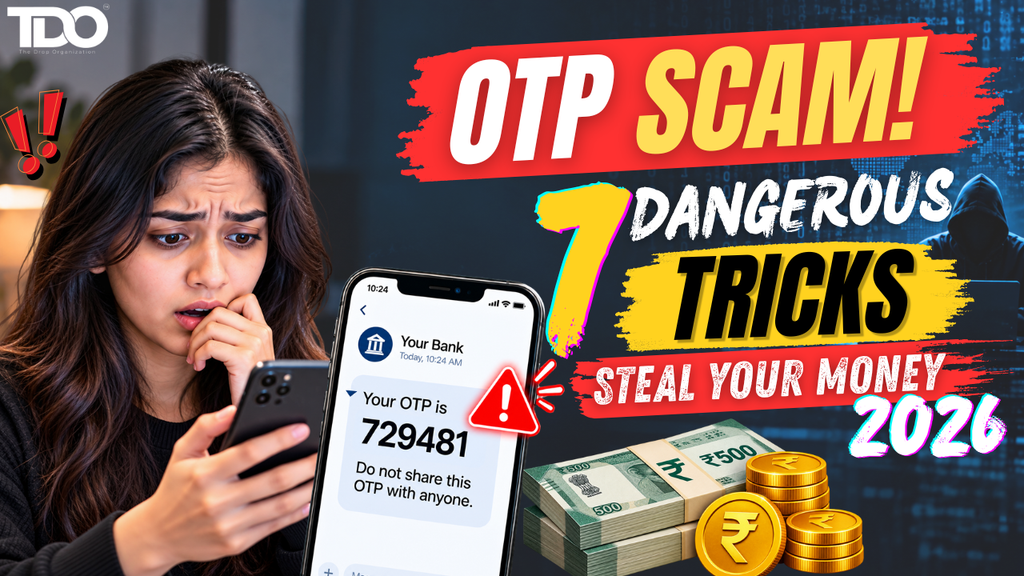
Learn how OTP scams work, how fraudsters trick victims into revealing OTPs, common warning signs, and powerful ways to protect your money from online fraud. You get a call from someone who says they are from your bank. You hear from someone who sounds professional, knows your name, and says you need to do an urgent security verification on your account. A couple of seconds later, you get an SMS with a six digit OTP. “Please share the OTP to complete the verification.” It sounds simple. You may even think that because the caller knows your name, phone number or some basic account information, they must be legitimate representatives of your bank. But this is just where the danger starts. OTP scams are designed around one simple idea: Make the victim voluntarily provide information that can help a fraudster complete an unauthorized transaction or gain access to an account. The technology may be sophisticated, but the psychological trick is often surprisingly simple. The scammer creates urgency, fear, excitement, confusion or trust and then encourages the victim to do something they normally wouldn’t. The Reserve Bank of India has been cautioning customers on several occasions not to share OTP, PIN, passwords, card details or any other confidential banking information with unknown persons. The RBI has also issued specific warnings about fraudsters posing as officials and using alarming claims such as account freezing or deactivation to pressure people into revealing sensitive information. So understanding OTP scams is not just a cybersecurity issue but also an important part of financial safety. In this article, we’ll break down OTP scams — what they are, the psychology behind them, the most common types, why people fall for them, and what to do if you get a suspicious call or if you’ve accidentally given out an OTP. Also Read: How to Start a Cybersecurity Career With No Experience: 7 Powerful Steps to Get Your First Job in 2026 What Are OTP Scams? Before understanding OTP scams, let us understand what an OTP actually is. OTP means One Time Password. It is a temporary code used to verify some transaction, login, account change, registration or other operation. For instance, when you attempt to make a specific transaction, your bank or service provider might send a code to your registered mobile number. The code is meant to prove that the actual account owner is authorizing the action. That is why OTP should be considered as confidential authentication information. An OTP is not simply another ordinary SMS. So if someone asks you for an OTP, the usual correct response is to stop and check what action is being authenticated before doing anything else. The main difference is that many OTP scams don’t involve the attacker “breaking” the OTP system at all. Instead the attacker tries to trick the victim into revealing the OTP. This is an example of social engineering . The criminal isn’t necessarily defeating the technology directly, but rather trying to influence the person using the technology. This makes OTP scams particularly interesting from a cybersecurity point of view, as the weakest link might not be the banking application, the encryption mechanism or the authentication infrastructure, but rather the human decision being made at the other end of the phone. OTP scams are so effective for a few reasons. The reason OTP scams continue to be a threat is that they combine technology with psychology. A fraudster might know that people are more likely to make mistakes when they are scared, rushed, excited or confused. So the scammer sets up a situation where the victim feels like they need to do something right now. Common emotional triggers are: This is why OTP scams are better understood as psychological attacks than just technical attacks. The criminal does not need to convince you that he’s a hacker. They have to persuade you that they can be trusted. Top OTP Scams You Should Know About 1. Fake Bank Verification OTP Scams This is one of the most common types of OTP scams. The victim receives a call from someone who claims to be a bank representative. The caller may say that the victim’s account needs to be verified, the debit card needs to be activated, KYC details need to be updated or suspicious activity has been detected. The dialog is supposed to be official sounding. The scammer might want to know things like: The last request is usually presented as a simple verification step. An OTP has been sent to your phone. “Just give me the number so I can look at your account.” But the OTP may actually be authorizing a transaction or some other security-sensitive action. The victim thus thinks they are going through a security process, when in fact they might be approving something the fraudster has started. The RBI has specifically cautioned that criminals pretending to be officials of the RBI or the government may threaten to freeze or deactivate an account to force a victim to disclose confidential information, including OTP. The best thing to do is simple: Never give an OTP to an unsolicited caller. If you suspect that your bank is really requiring something from you, please reach out to the bank independently via its official website, mobile app, branch or verified customer-care channel. 2. Fake KYC Update OTP Scams KYC related messages are another common theme in OTP scams. You may see a message that says: “Your KYC has expired. Your account will be suspended unless you update it immediately.” The message could include a link, or it may be followed by a phone call from someone claiming to be from a bank, payment service, telecom company or financial institution. The point is to cause panic. Sometimes when the victim responds, the fraudster may direct the victim to a verification process and eventually request an OTP. The issue is not that KYC procedures are inherently suspect. In reality, it’s the financial institutions that do KYC-related processes. The danger lies in allowing
The Human Firewall: Why Strong Cybersecurity Starts with You in 2026?
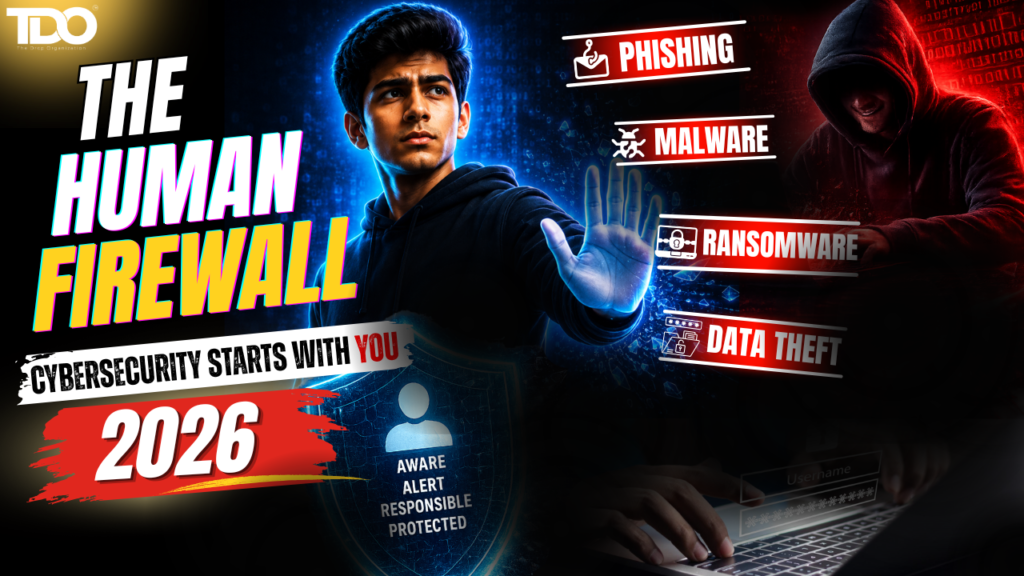
Discover why the human firewall is the strongest defense against cyber threats. Learn how cybersecurity awareness, smart online habits, and digital responsibility can protect you and your organization from modern cyber attacks. Imagine entering a building secured by biometric scanners, CCTV cameras, security guards and high tech alarm systems. “Every entry is watched, every visitor is checked, every step is noted. It’s almost impossible for an intruder to gain access, on the face of it. Now picture a stranger approaches an employee outside the building and says, “I forgot my access card. Please hold the door for me, okay?” The employee smiles and opens the door, wanting to be helpful. All of these costly security precautions come to nothing in a matter of seconds – not because the technology failed but because a person made an innocent decision. This is one of the simplest examples of why the concept of a human firewall has become one of the most significant discussions in contemporary cybersecurity. When most people think of cybersecurity they think of antivirus software, firewalls, encryption or advanced hacking tools. These technologies are important, but they often miss one important fact: The user of the security system is typically the strongest or weakest link in any security system. Every day hackers do millions of attacks across the world. Surprisingly, many of them don’t start off by attacking computers. Instead they go after people. They send believable emails, bogus job offers, fraudulent payment requests and real looking login pages. Not because software is feeble but because human behaviour is often easier to manipulate. That’s why organizations across the globe are investing not only in technology, but also in building a human firewall. It’s not software – a human firewall. A person with the awareness, knowledge and confidence to identify online dangers before they become security incidents. Cybersecurity doesn’t begin at the computer in today’s digital world. It starts with you. Also Read:- 4 Cybercrime Psychology Secrets: Why People Get Hacked? What Is a Human Firewall? The human firewall is a term used to describe people who are actively protecting themselves and their organization by making smart decisions around cybersecurity. A human firewall acts like a traditional firewall filtering bad network traffic, but filters bad email, bad links, unexpected calls and strange online activities before they do damage. Let’s put it this way. Technology can stop many known attacks. But technology can’t always tell you whether to trust a message claiming to be from your bank. It cannot tell if an email asking for an urgent payment is genuine. Sometimes it does not know when someone is trying to play on your emotions. Enter the human firewall. One important question can help a smart employee, student or web user to prevent an attack: “This looks legit?” That one moment of awareness can sometimes thwart financial fraud, identity theft, ransomware infections, or data breaches. Why Cybersecurity Isn’t Just About Technology Anymore? For many years, cybersecurity was almost entirely focused on technical defenses. Companies bought antivirus software. Firewalls installed. Configured intrusion detection systems. Encrypted sensitive information. These measures are still important, but cybercriminals have evolved. Instead of attacking the technology directly, they began attacking the people using it. Think about investing millions to protect your company’s servers, only to have an employee unknowingly distribute login credentials with a phony email. The technology worked perfectly. The attack worked because of how people behave. That is precisely why the concept of the human firewall has grown more and more significant. Today’s cybersecurity professionals know that it’s not enough to protect computers. People must also understand how cyber attacks work. They need to know. They need to think critically. But most importantly, they need confidence to question suspicious situations. Why Humans Are the First Line of Defense? Cybersecurity is often mistakenly viewed as an IT department responsibility. In fact, anyone who uses a smartphone, laptop, email account or social media is part of an organization’s cybersecurity strategy. Every employee, every student, every teacher, every business owner, every internet user, every choice they make builds up a feeling of safety or exposure. A good human firewall can spot the warning signs before clicking on a suspicious attachment. They check for unexpected requests. They make good passwords. They support Multi Factor Authentication. They report unusual activity rather than ignoring it. In most cases, these simple actions will stop attacks before cybersecurity software is ever involved. This is why more and more experts are talking about people as the first, and often most important, line of defense. The Costliest Cybersecurity Mistake Isn’t Technical Suppose you posed the question: “What is the greatest cyber security threat today?” Most people would say: Malware, Ransomware, Hackers, Viruses, Artificial Intelligence. These are all serious threats, but cybersecurity reports keep pointing to another issue: A human error. Clicking the wrong link, sharing confidential information, using weak passwords, not paying attention to software updates, accessing open WiFi., downloading apps from unknown sources. Each one of these seemingly small choices can open the door for attackers. This is not to say people are careless. It just means people are busy. We’re distracted. We’re curious. We’re emotional. Most people don’t realize how well cybercriminals understand these behaviors. That’s why building a human firewall is no longer optional. It’s becoming a necessity. Hackers Don’t Hack Computers First- They Hack People One of the greatest myths regarding cybersecurity is that hackers spend all their time writing complex code. In reality, many successful cyber-attacks start with a simple chat. A fake email. A scam phone call. A convincing LinkedIn message. A QR code placed in a public location. A social media advertisement. Each attack is carefully crafted around human psychology. Attackers know people trust known brands. They know students react quickly to internship opportunities. They know that employees fear the loss of access to company accounts. They know that panic breeds urgency, Cybercriminals often try to convince people to bypass security software, not try to beat it. And that’s