
What Are Phishing Attacks? 7 Dangerous Phishing Attacks You Must Know in 2026
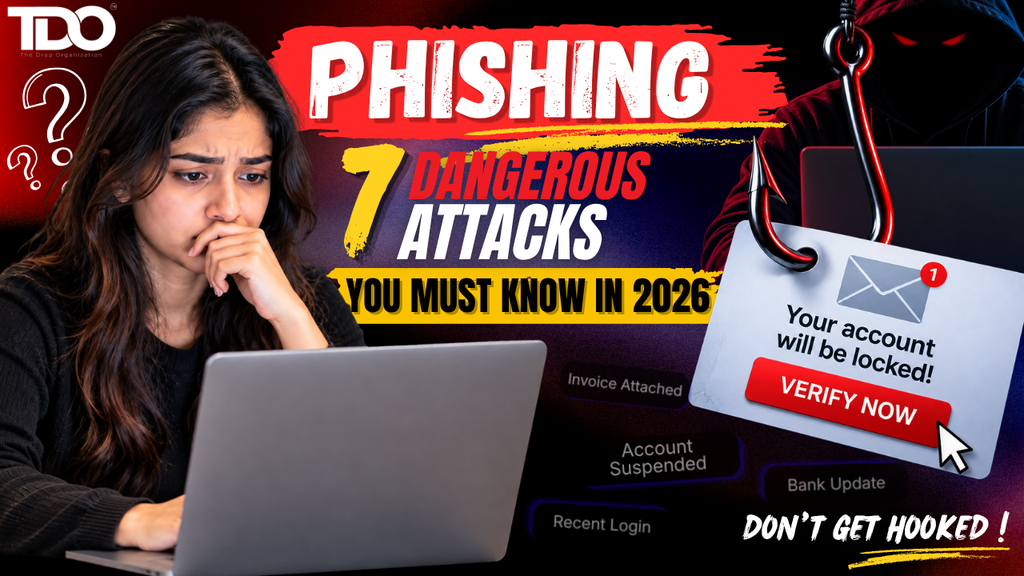
Discover what phishing is, how modern phishing attacks work, and the 7 dangerous phishing attacks you should recognize in 2026, from email phishing and smishing to vishing, QR scams, and AI-powered threats. Let’s say you get an email that looks like it’s from your bank where the logo is correct and the colors seem familiar. The message says it has found suspicious activity on your account and asks you to verify your identity right now. You click the button & see a login page. It looks almost exactly like the actual banking website. You type in your username and password thinking that you are just protecting your account and within a couple minutes later the attacker has what they wanted. What you have just seen is one of the most common types of phishing attacks & the frightening part is that you don’t necessarily need to be careless or inexperienced to become a victim. Modern phishing attacks are more personalized, professionally designed, automated, and delivered on channels people naturally trust. Microsoft Threat Intelligence identified about 8.3 billion email phishing attacks in the first quarter of 2026. QR-code phishing proved to be the fastest-growing attack vector during this time. The threat was carried into the second quarter. From April to June 2026, Microsoft identified around 7.6 billion phishing emails as attackers broadened their targeting of workplace platforms and voice-based social engineering. These numbers are not meant to scare you. They point to something much more useful: Understanding phishing attacks has become a basic digital-safety skill. So what is phishing? How do these attacks function? And if everyone knows about phishing, why do people still fall for them? And most importantly, what can you do to protect yourself? Let’s break it down. Also Read:- How to Secure Your Google Account: 7 Powerful Google Account Security Settings You Should Change Today What Are Phishing Attacks? Phishing attacks are cyberattack where criminals pose to be a trusted person, organization, company, platform, or service to trick someone into giving away sensitive information, clicking a malicious link, downloading dangerous content, transferring money, or gaining access to an account. In simple terms, the attacker creates a situation in which you think: “This is legitimate.” And then asks you to do something that will help them. This action can be entering a password, sharing an OTP, opening an attachment, approving a login request, scanning a QR code or making a payment. Microsoft defines phishing attacks as an attempt to steal money or identity information by tricking users into providing sensitive information via websites or messages that look legitimate. This is why phishing attacks are closely connected to social engineering attacks. The attacker may use technology to deliver the message, but psychology often does much of the heavy lifting. Fear, urgency, curiosity, authority, greed, and trust can all become weapons. Why Are Phishing Attacks So Successful? If phishing attacks were such a huge problem, why do people simply disregard these suspicious messages Because they understand human behavior. Simply check out these two messages. Message A: “Hello. Please review this document when convenient.” Nothing particularly urgent. Message B: “URGENT: Your bank account will be permanently suspended in 15 minutes. Verify your identity immediately.” The second message is a pressure point. Your brain begins to think: “What if this is real?” That’s the window the burglar is after. The newer phishing scams are designed to close the gap between receiving the message and acting on it. The less time you spend analyzing the situation, the greater the possibility that you’ll make an impulsive decision. And attackers have become better at creating believable situations. The message may mention your employer, a recent purchase, a service you use or a topic that is in the news. The attack does not have to be obviously fake. It just has to look real enough. The Evolution of Phishing Attacks in 2026 Phishing attacks were once dubious emails asking you to click on a strange link. This still occurs. But phishing attacks have expanded far beyond the inbox. Today, you may be the victim of phishing by email, SMS, phone calls, QR codes, social media, collaboration platforms, fake login pages, malicious advertisements, messaging applications & AI-generated content. Microsoft’s 2026 threat reporting demonstrates the way fast attackers can pivot delivery methods. Its Q2 report also found ongoing growth in Teams-based social engineering and vishing, while QR-code phishing experienced large fluctuations following the disruption of a large phishing-as-a-service ecosystem. Similarly, Barracuda found that phishing comprised 48% of malicious email activity in its January 2026 dataset in its 2026 Email Threats Report, with 90% of high-volume phishing campaigns utilizing phishing-as-a-service kits. Thus, a phishing attack is no longer just: “Someone sends you a suspicious email. It’s becoming an ecosystem. 7 Phishing Attacks to Watch Out for in 2026 Now, let us talk about 7 major types of phishing attacks that average users and businesses should be aware of. 1.Email Phishing Attacks: The Old-School Attack That Still Works Let’s start from the most familiar form. Email phishing attacks involve sending fraudulent emails that appear to come from a legitimate company, organization, colleague or service. You may receive an email that appears to be from your bank, Google, Microsoft, Amazon, your employer, a courier company, a university, a social media platform or a government organization. Usually, the message will include some sort of request where you may be asked to confirm your account or maybe your payment failed or maybe your subscription is expiring or perhaps a document needs to be reviewed or maybe some suspicious activity has been spotted. The story is different but the aim is the same: Get you to interact with something controlled by the attacker. Microsoft says suspicious messages often contain urgent calls to action or threats and recommends that users avoid clicking on links or opening attachments in suspicious messages, but instead visit the legitimate website of the organization independently. Want to know if an email is a scam? Pay attention to combinations of: However,
The Human Firewall: Why Strong Cybersecurity Starts with You in 2026?
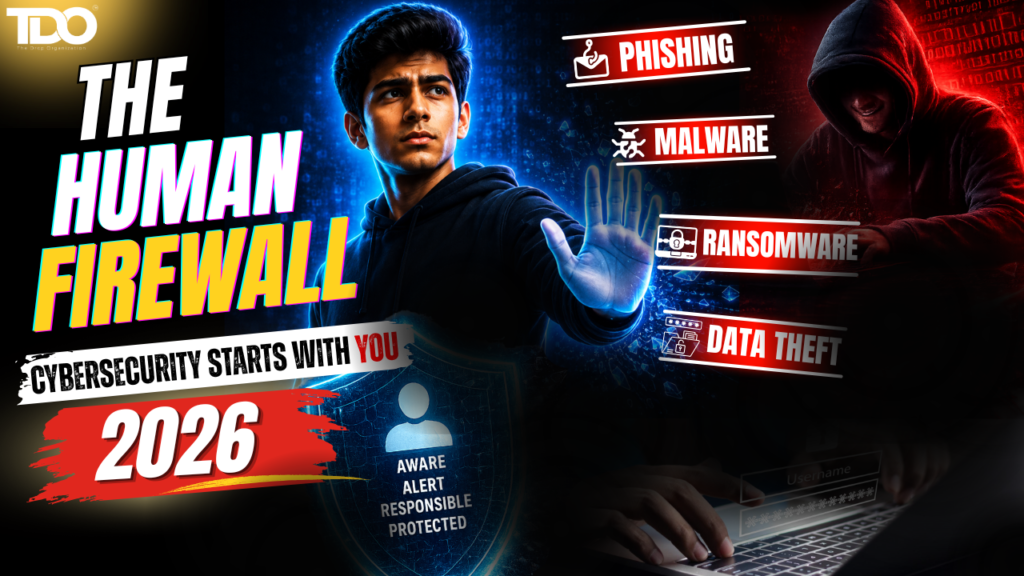
Discover why the human firewall is the strongest defense against cyber threats. Learn how cybersecurity awareness, smart online habits, and digital responsibility can protect you and your organization from modern cyber attacks. Imagine entering a building secured by biometric scanners, CCTV cameras, security guards and high tech alarm systems. “Every entry is watched, every visitor is checked, every step is noted. It’s almost impossible for an intruder to gain access, on the face of it. Now picture a stranger approaches an employee outside the building and says, “I forgot my access card. Please hold the door for me, okay?” The employee smiles and opens the door, wanting to be helpful. All of these costly security precautions come to nothing in a matter of seconds – not because the technology failed but because a person made an innocent decision. This is one of the simplest examples of why the concept of a human firewall has become one of the most significant discussions in contemporary cybersecurity. When most people think of cybersecurity they think of antivirus software, firewalls, encryption or advanced hacking tools. These technologies are important, but they often miss one important fact: The user of the security system is typically the strongest or weakest link in any security system. Every day hackers do millions of attacks across the world. Surprisingly, many of them don’t start off by attacking computers. Instead they go after people. They send believable emails, bogus job offers, fraudulent payment requests and real looking login pages. Not because software is feeble but because human behaviour is often easier to manipulate. That’s why organizations across the globe are investing not only in technology, but also in building a human firewall. It’s not software – a human firewall. A person with the awareness, knowledge and confidence to identify online dangers before they become security incidents. Cybersecurity doesn’t begin at the computer in today’s digital world. It starts with you. Also Read:- 4 Cybercrime Psychology Secrets: Why People Get Hacked? What Is a Human Firewall? The human firewall is a term used to describe people who are actively protecting themselves and their organization by making smart decisions around cybersecurity. A human firewall acts like a traditional firewall filtering bad network traffic, but filters bad email, bad links, unexpected calls and strange online activities before they do damage. Let’s put it this way. Technology can stop many known attacks. But technology can’t always tell you whether to trust a message claiming to be from your bank. It cannot tell if an email asking for an urgent payment is genuine. Sometimes it does not know when someone is trying to play on your emotions. Enter the human firewall. One important question can help a smart employee, student or web user to prevent an attack: “This looks legit?” That one moment of awareness can sometimes thwart financial fraud, identity theft, ransomware infections, or data breaches. Why Cybersecurity Isn’t Just About Technology Anymore? For many years, cybersecurity was almost entirely focused on technical defenses. Companies bought antivirus software. Firewalls installed. Configured intrusion detection systems. Encrypted sensitive information. These measures are still important, but cybercriminals have evolved. Instead of attacking the technology directly, they began attacking the people using it. Think about investing millions to protect your company’s servers, only to have an employee unknowingly distribute login credentials with a phony email. The technology worked perfectly. The attack worked because of how people behave. That is precisely why the concept of the human firewall has grown more and more significant. Today’s cybersecurity professionals know that it’s not enough to protect computers. People must also understand how cyber attacks work. They need to know. They need to think critically. But most importantly, they need confidence to question suspicious situations. Why Humans Are the First Line of Defense? Cybersecurity is often mistakenly viewed as an IT department responsibility. In fact, anyone who uses a smartphone, laptop, email account or social media is part of an organization’s cybersecurity strategy. Every employee, every student, every teacher, every business owner, every internet user, every choice they make builds up a feeling of safety or exposure. A good human firewall can spot the warning signs before clicking on a suspicious attachment. They check for unexpected requests. They make good passwords. They support Multi Factor Authentication. They report unusual activity rather than ignoring it. In most cases, these simple actions will stop attacks before cybersecurity software is ever involved. This is why more and more experts are talking about people as the first, and often most important, line of defense. The Costliest Cybersecurity Mistake Isn’t Technical Suppose you posed the question: “What is the greatest cyber security threat today?” Most people would say: Malware, Ransomware, Hackers, Viruses, Artificial Intelligence. These are all serious threats, but cybersecurity reports keep pointing to another issue: A human error. Clicking the wrong link, sharing confidential information, using weak passwords, not paying attention to software updates, accessing open WiFi., downloading apps from unknown sources. Each one of these seemingly small choices can open the door for attackers. This is not to say people are careless. It just means people are busy. We’re distracted. We’re curious. We’re emotional. Most people don’t realize how well cybercriminals understand these behaviors. That’s why building a human firewall is no longer optional. It’s becoming a necessity. Hackers Don’t Hack Computers First- They Hack People One of the greatest myths regarding cybersecurity is that hackers spend all their time writing complex code. In reality, many successful cyber-attacks start with a simple chat. A fake email. A scam phone call. A convincing LinkedIn message. A QR code placed in a public location. A social media advertisement. Each attack is carefully crafted around human psychology. Attackers know people trust known brands. They know students react quickly to internship opportunities. They know that employees fear the loss of access to company accounts. They know that panic breeds urgency, Cybercriminals often try to convince people to bypass security software, not try to beat it. And that’s
4 Cybercrime Psychology Secrets: Why People Get Hacked?
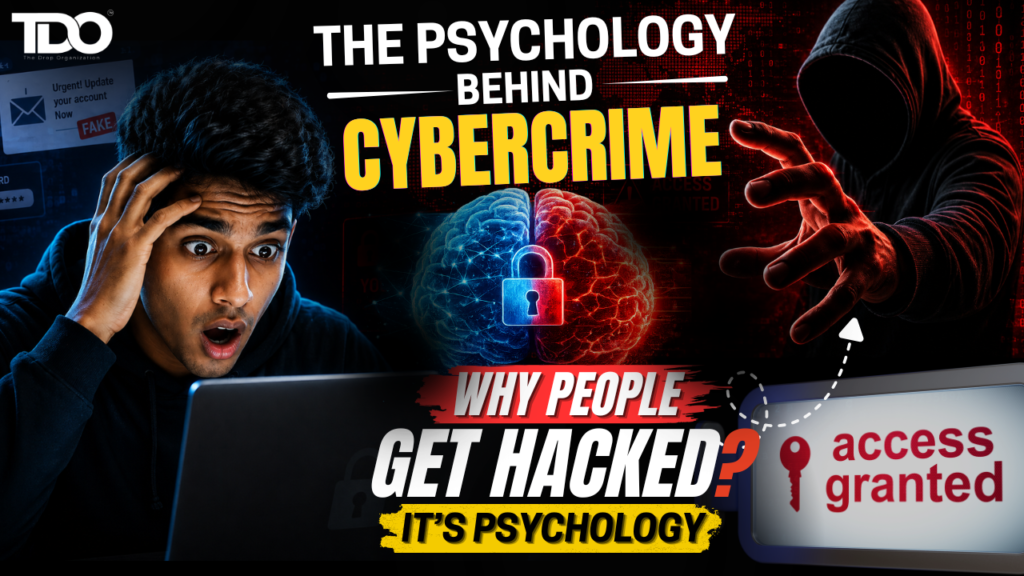
Discover the truth behind cybercrime psychology and learn why people become victims of cyber attacks. Explore the human side of hacking, common psychological tricks used by cybercriminals, and practical ways to stay protected. Think of a phone call from your bank telling you that your account has been compromised. The voice on the phone is calm, professional and oddly convincing. You share an OTP to “secure” your account without thinking twice. A few minutes later your savings are washed away. Now ask yourself one simple question. Was your phone hacked because it was too weak? Or were you hacked because somebody knew your mind better than your device? This is the point where the cybercrime psychology concept becomes very important. When you hear the word hacker, you generally picture people sitting in dark rooms, surrounded by computer screens, typing complex code to break into secure systems. In the movies they’re portrayed as technical geniuses who can outsmart sophisticated security software. Most successful cyber attacks don’t even start with computers. They start with understanding people. Computers don’t usually make emotional decisions and cyber criminals know that. Humans do. That’s why modern cybercrime is as much psychology as technology. Attackers often attack firewalls after attacking fear, curiosity, trust, excitement, greed and urgency. They play on human emotions until the victims, unknowingly, allow them access. This secret science is called cybercrime psychology and knowing it can drastically cut down your chances of being the next victim. In this blog, we will discuss why having a high IQ doesn’t prevent people from falling for online scams, how cybercriminals exploit human behavior, and why cybersecurity is no longer just about protecting computers, but protecting the human mind. Also Read:- 7 Digital Marketing Myths You Should Stop Believing in 2026 What is Cybercrime Psychology? Before we start with the question of how hackers manipulate people, let’s learn what the science of cybercrime psychology actually is. In simple terms, cybercrime psychology is the study of how cybercriminals exploit human thoughts, emotions, habits, and decision making to successfully carry out cyber attacks. Hackers know one important truth. It is difficult to get into a secure computer. Convincing a person to open the door is often much easier. Attackers will spend minutes to craft convincing emails, fake websites or persuasive phone calls rather than spending weeks searching for software vulnerabilities. But in reality, they aren’t really after your computer. It’s your decision making. Grasping the cybercrime psychology assists in understanding why people click on dubious links, download infected files, believe fake messages or give away confidential information without knowing the consequences. That’s why cybersecurity experts often say, “Humans are the weakest link in cybersecurity.” Not because people are not smart. But because people naturally trust, respond emotionally and make snap decisions under pressure. Why Cyber Criminals Attack People, Not Computers? Technology is very advanced. The companies spend millions on firewalls, encryption, anti-virus software and intrusion detection systems. Banks have whole teams of cybersecurity experts. Big organizations do security audits on a regular basis. It’s not impossible to break through these defenses, but it takes work. Humans, however, are unpredictable. People are tired. People get sidetracked. People get curious. People panic. People trust authority. Cybercriminals have a remarkable insight into these behaviors. This understanding underpins cybercrime psychology. Attackers often ask themselves a much simpler question instead of attacking complicated software: “How can I convince someone to give me access willingly?” This method saves time and increases the success rates. For example you might get an email that says something like this: ” Your email account will be deleted forever in 1 hour if you do not verify your password right now. ” Many people won’t bother to check the sender. Fear takes over instead. They clicked on the link. Enter their password. And unwittingly surrender their credentials. The computer had not been cracked. The person had been set up. The Human Brain: The Biggest Security Weak Link One of the most interesting things about cybercrime psychology is how our brains respond to emotion. Humans don’t make decisions based on pure logic. But emotions play a part in almost every important decision we make. These emotional shortcuts are carefully exploited by cybercriminals. They create situations where victims cooperate willingly. They do not force victims to act. Here are some of the most common psychological triggers: The Deadliest Weapon: Fear One of the strongest human feelings has been fear. Cybercriminals know this very well. Now imagine getting this message: “Your bank account has been frozen.” Or, “The Income Tax Department has detected suspicious activity.” Or, “Your social media account will be permanently disabled today.” Most people stop thinking rationally immediately. Instead they will solve the problem. The urgency causes mistakes. Victims click on malicious links. Download of fake applications. Show passwords. Share OTPs. The attack is successful because fear overrides logic. This emotional manipulation is one of the most obvious examples of cybercrime psychology at work. Curiosity Makes People Click Did you ever get messages saying: “Who checked your profile?” “Private video leaked.” “Congrats! “You got a new phone. See what someone said about you.” The purpose of these messages is one. To spark curiosity. Curious, it is natural. Humans are always searching for new information. Cybercriminals know this all too well. When curiosity starts, many people ignore warning signs. They click on links they don’t know. Download files that seem suspicious. Install bogus apps. Sometimes mere curiosity is sufficient to bring down a whole system. That’s why cyber security experts keep telling people to verify information before clicking on anything online. We can understand cybercrime psychology to know that it is not always technical hacking that hackers do. Sometimes they count only on human curiosity. Trust: The Door Hackers Walk Through Invisibly Trust is what makes society work. We believe in our banks. We depend on our employers. We depend on delivery companies. We trust friends. Unfortunately, cyber criminals take advantage of this behavior. Imagine getting an email that looks