Understand how attackers plan real-world cyber attacks
Beginner Cybersecurity Foundation
EHF 2.0Ethical HackingFundamentals.
A beginner-to-intermediate cybersecurity course designed to build a strong foundation in ethical hacking, networking, reconnaissance and bug bounty concepts from an ethical and defensive perspective.
Learn attacker thinking through authorized labs, ethical boundaries and defense-first practice.
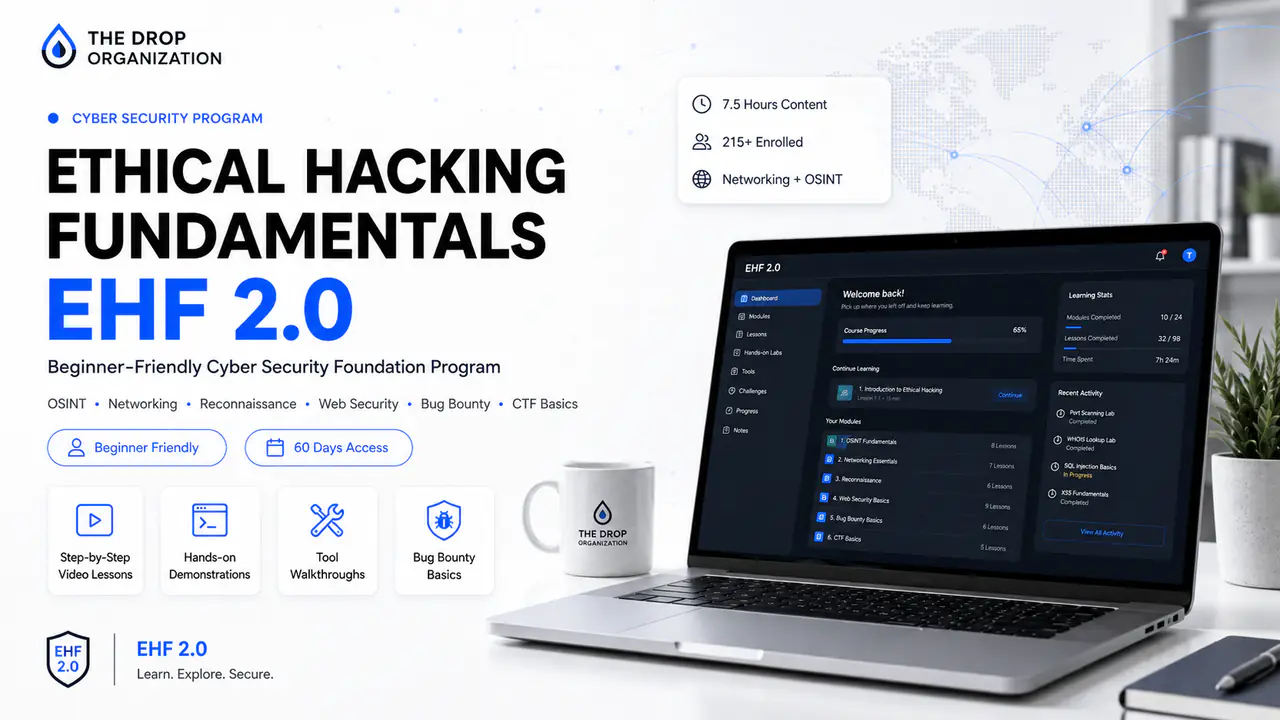
Course at a glanceLive + Recorded · 5h 55m
EHF 2.0Course Version
BeginnerStarting Level
4Core Modules
LifetimeContent Access
About Course
Build Practical Cybersecurity Awareness
EHF focuses on how real-world attacks work, how information is gathered, how networks behave and how vulnerabilities are identified while keeping the training ethical, educational and defense-first.
Identify phishing, social engineering and malware-based threats
Understand computer networking, protocols and data flow
Discover open ports, services and exposed systems in authorized labs
Understand XSS, SQL Injection and common web attack vectors
Build practical problem-solving skills using CTF-style learning
Learn attacker mindset to better defend systems and users
Perform information gathering using OSINT, domains, IPs and search techniques
Analyze network traffic and identify suspicious behavior
Learn web security fundamentals and OWASP Top 10 vulnerabilities
Gain structured knowledge of WAPT, VAPT and bug bounty workflows
28 guided lessons5h 55m of structured course content
Start With The Right Foundation
Everything a beginner needs.
Everything a beginner needs.
Nothing they do not.
No prior hacking experience is required. The course builds practical awareness step by step, then connects it to networking, web risks and responsible security workflows.
Ethics first
All exercises and concepts are intended for authorized, educational and defensive use only.
- Step-by-step video lessons
- Real-world examples and attack scenarios
- Hands-on demonstrations and tool walkthroughs
- Practical learning modules for networking and security
- Bug bounty and OWASP-based explanations
- CTF-style problem-solving guidance
- Lifetime access to course content
- Basic computer or mobile skills, including internet use
- Laptop or desktop system (Windows/Linux recommended)
- Curiosity and willingness to learn cybersecurity concepts
- No prior hacking experience required
- Course content to be used for ethical and educational purposes only
- 01Students interested in cybersecurity and ethical hacking
- 02Beginners with no prior hacking or security experience
- 03IT and Computer Science students
- 04Aspiring penetration testers and bug bounty hunters
- 05Developers who want to understand web security risks
- 06Network and system administrators
- 07Anyone interested in learning cybersecurity fundamentals
Structured EHF 2.0 Curriculum
The lessons are organized from attack-awareness basics to OSINT, networking and bug bounty fundamentals.
- 28
- Lessons
- 5h 55m
- Total runtime
01Module 1: How Attackers Operate4 lessons
- Payload concepts, misuse risks and defensive detection
- Remote Access Trojans: risk awareness and system-control indicators
- Social engineering and camera-permission abuse prevention
- Phishing frameworks, credential-theft risks and user protection
02Module 2: Information Gathering6 lessons
- Google dorking: advanced search operators and sensitive data discovery
- WHOIS: domain registration and IP ownership lookup
- OSINT and dark web awareness for open-source intelligence
- Wappalyzer: website technology profiling and fingerprinting
- Shodan: internet-connected device discovery concepts
- Banner grabbing: identifying services and versions in authorized labs
03Module 3: Computer Networking8 lessons
- What is networking: fundamentals, protocols and hardware
- Playing with IP addresses: Ping and Traceroute diagnostics
- Nmap: network discovery, port scanning and service auditing
- IP rotation: privacy concepts, rate limits and legal boundaries
- HTTP vs HTTPS: web communication protocol comparison
- Wireshark: packet inspection and network traffic analysis
- ARP attack concepts: MITM risks and defensive detection
- Host discovery: mapping authorized targets before scanning
04Module 4: Bug Bounty Training10 lessons
- Bug vs vulnerability: software glitches and security flaws
- HackerOne: vulnerability disclosure platform introduction
- Subdomain enumeration for authorized programs
- OWASP Top 10: critical web risk awareness
- Burp Suite: web security testing and proxy workflow
- XSS: cross-site scripting mechanics and prevention
- SQLi: SQL injection concepts and database risk awareness
- WAPT explained: web application testing fundamentals
- VAPT explained: vulnerability assessment and testing fundamentals
- CTF basics: how capture-the-flag builds real-world skills
Learning EnvironmentUnderstand the tools.
Understand the tools.
Respect the boundaries.
Explore the platforms used across network analysis, reconnaissance and web-security learning inside controlled, authorized practice.

Kali Linux
Security lab environment
Nmap
Network discovery
Wireshark
Traffic analysis
Burp Suite
Web testing workflow
HackerOne
Disclosure platform
Why EHF
A Clean Start For Cybersecurity Learners
This course is ideal for learners who want practical cybersecurity awareness, hands-on thinking and industry-relevant skills before moving into advanced ethical hacking, THT or VAPT paths.
EHF is kept separate from advanced tracks so beginners get the right foundation first: networking, attack awareness, OSINT, OWASP, bug bounty basics and ethical boundaries.
- 01Learn the fundamentals
Attack awareness, information gathering, networking and web-security concepts.
- 02Practice responsibly
Follow tool demonstrations and problem-solving exercises inside authorized learning environments.
- 03Choose your next track
Move forward with a stronger base for THT, VAPT or bug-bounty learning paths.
Start Your Cybersecurity FoundationLearn the mindset.
Learn the mindset.
Build the discipline.
Talk to the TDO team about upcoming batches, access, eligibility and the EHF 2.0 learning journey.
Book Appointment