
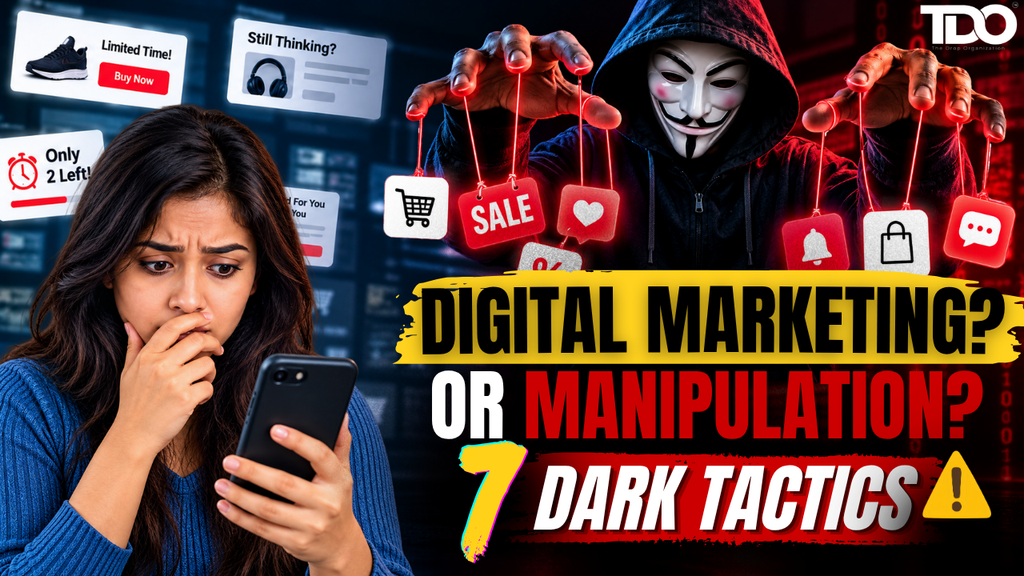
Discover 7 manipulative digital marketing tactics used to influence online consumers, from dark patterns and fake urgency to hidden advertising and personalized persuasion, and learn how to recognize them.
You’re scrolling through Instagram and suddenly you see a product that seems almost too relevant to your interests. You click on the ad and go to the website and see a message that says “Only 2 left!” A countdown timer begins to tick. You put the product in the cart and suddenly another offer pops up, ” Add this now and save ₹499″. You halt. Then another message comes:
“Don’t leave now! Your special discount expires at 03:42. You buy it.
But then you start to wonder: Was I really wanting this product or was I pressured into buying it?
This question is at the heart of the dark side of modern digital marketing tactics.
Digital marketing has changed the way businesses speak to customers. Search engines, social media, websites, email campaigns, influencers, recommendation engines and online advertising – they all give brands a uniquely precise way to reach audiences. Many of these techniques are perfectly legitimate and useful. Relevant advertising can help consumers find products, compare options and find services that truly solve their problems.
The problem is that digital marketing tactics are created not only to persuade but to confuse, to pressure, to hide, to exploit predictable psychological reactions. These practices are often described in terms such as dark patterns, manipulative marketing, deceptive design and misleading advertising.
The issue is significant enough that regulators and advertising organizations have increasingly focused on it. A 2024 international study led by the U.S. The Federal Trade Commission and consumer-protection networks looked at 642 subscription websites and apps in several countries and found that nearly 76% exhibited at least one possible dark pattern and nearly 67% exhibited multiple possible dark patterns.
Authorities also emphasized that identifying a potential dark pattern did not in itself demonstrate that the practice was illegal. The Federal Trade Commission India has also formally dealt with the subject. The 2023 guidelines of the Central Consumer Protection Authority identify 13 dark patterns, including false urgency, basket sneaking, confirm shaming, forced action, subscription traps, interface interference, bait and switch, drip pricing and disguised advertisements.
In 2025, the Indian government instructed e-commerce platforms to conduct self-audits and eliminate such practices. So, what exactly are these digital marketing tactics, how do they influence us, and how can ordinary consumers recognize them?
Let’s explore seven of the most important digital marketing tactics.
Also Read:- OTP Scams Explained: 7 Dangerous Tricks Hackers Use to Steal Your Money in 2026
What are Manipulative Digital Marketing Tactics?
Before we look at individual examples it is important to make one distinction. Persuasion is not automatically manipulation.
Marketing is supposed to persuade people. To be clear, saying something good about a product in an ad, really giving a discount, or putting a post on social media about why a service is useful isn’t cheating, but it can influence your decision to buy something. The problem begins where the method affects the capacity of a person to make a real choice.
Dark patterns, as defined by the Advertising Standards Council of India, are practices related to online choice architecture that can mislead, coerce or manipulate consumers and may lead to consumer detriment. Its guidelines discuss examples such as hidden information, pre-selected choices, disguised advertising and other techniques that can shape decisions.
So, not all persuasive advertisements fit the category of harmful digital marketing tactics. One way to think about the difference is:
Persuasion: “Here is why this product may be useful to you.”
Manipulation: “Here is a carefully designed experience intended to make you act before you understand what you are agreeing to.”
This distinction becomes much clearer when we look at the digital marketing tactics themselves.
1. Fake Urgency: “Buy Now or You Will Miss Out!”
You probably have seen this one. “Just 2 left! ” or “Sale ends tonight!” or “This offer ends in 10 minutes!” or “37 people are looking at this product right now!”
Urgency is one of the oldest tricks in the marketer’s book, but digital channels can make it much more effective. You can show a countdown timer next to a product. When you arrive at a website, you may immediately see a notification. An ad can tell you over and over that the chance is disappearing. Sometimes it’s a genuine emergency.
A business can only have so much in stock, or a promotion may actually end at a certain time. The problem arises when urgency is manufactured or falsely framed. This is called false urgency and is one of the dark patterns of digital marketing tactics flagged by India’s consumer-protection guidelines.
Why does it work?
Because urgency alters the decision-making context. So instead of asking: “Do I want this?”, you begin to ask: “What if I miss it?”
That’s a whole different psychological issue. FOMO, or the fear of missing out , can cause consumers to make choices they might rethink with a little more time . This is why fake urgency is one of the most recognizable digital marketing tactics, consumers should learn to identify.
How to protect yourself?
Before responding to a countdown or “last chance” message, ask yourself:
- Is the deadline well explained?
- Is it really a temporary offer?
- Would I want this product tomorrow?
- Is it really less expensive than usual?
- Am I buying it because I need it or because I feel pressured?
Sometimes, a five-minute wait is enough to break the psychological effect of digital marketing tactics.
2. Hidden Costs and Drip Pricing
Imagine you find a flight, hotel room, subscription, or online product for a great price. You think:
“That’s surprisingly affordable.”
You walk to the register. Then there’s a service charge. Then a platform charge. Then a processing fee and then a convenience fee. Suddenly the final amount looks very different from the price that attracted you in the first place.
This is a common practice associated with drip pricing where extra costs are revealed in stages during the purchase process. Of course, not all extra fees are inherently misleading. Businesses may charge legitimate taxes, delivery fees or service charges. The worry is that the price information isn’t transparent enough so that consumers know what they’re really buying before they make a decision.
India’s dark-pattern guidelines specifically list drip pricing among the practices covered by its framework. This is particularly relevant to online shopping where it is easy to present a nice initial price but defer the not so nice information to later. This means that drip pricing is one of the digital marketing tactics to consider when comparing products online.
What can you do?
Instead of comparing only the headline price, compare the final payable amount. Look carefully for delivery fees, platform charges, taxes, processing fees, subscription charges, renewal prices, cancellation charges or optional add-ons. The real price is the money going out of your bank account, not necessarily the number showing in the first ad.
3. Subscription Traps: Easy to Get In, Hard to Get Out
Have you ever seen how easy it is to sign up for a free trial?
Click → Confirm → Enter your payment details → And done.
But as soon as you decide you no longer want the service, suddenly the process to cancel is complicated. You might have to click through multiple pages, look in account settings, answer multiple questions or repeatedly confirm that you really want to leave. Sometimes this is called a subscription trap.
The business objective is straightforward: keep customers. But the consumer experience becomes problematic when the cancellation process is intentionally made significantly more difficult than the sign-up process. The international FTC/ICPEN review found that subscription services were frequently using potential dark patterns including practices that might make cancellation or consumer choices more difficult. This is a good example of the overlap of interface design and digital marketing tactics.
Marketing doesn’t end when the customer clicks “buy.” The digital experience encompasses the full customer journey—from acquisition to subscription to renewal to cancellation. Before you start a free trial watch out for: When does the trial end? What will I be billed for? What is the recurring subscription cost? Can I cancel online? What if I don’t cancel?
From a decision-making perspective, a “free” trial is not really free if you’re not paying attention to what happens next.
4. Hidden Ads: When Ads Are Not What They Seem
Now, let’s talk about social media. You see a creator talking with enthusiasm about a skincare product, a smartphone, a restaurant, a financial service, or a clothing brand.
The content seems natural. It looks like a recommendation from someone you follow. But what if the creator is getting paid to push the product?
Sponsored content is fine. Influencer marketing is a real form of advertising today. The issue arises when commercial intent is masked as digital marketing tactics.
The ASCI’s digital advertising guidelines require that consumers be able to identify promotional content and know when there is a commercial intent. Its guidance points out that consumers might not be aware that when advertising and normal content are blurred the message is meant to influence their behavior for commercial benefit. This is where disclosures such as #Ad, #Sponsored or other appropriate labels come in. The same principle applies beyond influencers.
Native advertising, sponsored articles and promotional search results can resemble editorial or user-generated material. This is one of the subtle digital marketing tactics that consumers should be on the lookout for: the deliberate obscuring of commercial communication.
A simple question can help: “Who benefits if I believe this recommendation?”
It does not mean that you should distrust any influencer or advertisement. It means you need to understand the relationship between the person recommending something and the company selling it.
5. Personalized Advertising That Knows Too Much
This is probably the most exciting area of modern digital marketing tactics. You look for jogging shoes. You are watching a fitness video. You are on a sports site. And then you start seeing ads for running shoes on other platforms. You might think: “How did they know I wanted this?”
There are a variety of ways to target and personalize audiences.
Google says that personalized advertising can use information such as activity and interests to make ads more relevant, while offering users controls through tools such as My Ad Center. Personalization isn’t necessarily manipulative. Targeted advertising, in fact, can be a good thing. If you really want to find something, the ads might save you time.
The worry is when personalization is so extensive, opaque or psychologically targeted that consumers are left in the dark about how their data is being used or how the targeting impacts the content they see. That’s why personalized advertising is such a critical part of the larger conversation about digital marketing tactics.
The better question is not simply: “Are targeted ads a bad thing?”
It is: “What data is being used, why is it being used, and what power does the consumer have?”
Google provides tools that let users manage some aspects of ad personalization, and view information about their advertising experience. These controls are for users when they want to know more about their advertising preferences.
6. Social Proof That Pretends to Be Trustworthy
“10,000 people bought this!”
“Best seller!!”
“Just 5-star reviews!”
“Everyone is doing it!
Such statements are examples of social proof. Social proof, in and of itself, is not unethical. Real customer reviews, real sales numbers and real testimonials can help people make better purchasing decisions. The problem comes when social proof is fabricated, exaggerated or presented without enough context.
Imagine seeing a product with hundreds of glowing reviews, only to find out later that some of those reviews were fake or gamed. Your perception of the product has already changed. This works because humans naturally look to other people’s behavior when making uncertain decisions. If everyone else seems to trust a product, we may feel more comfortable trusting it ourselves. When used responsibly, that makes social proof one of the most powerful digital marketing tactics—and one of the most misleading when it’s manufactured.
Look beyond the number instead of asking only: “How many reviews are there?” also ask:
– Are the reviews detailed?
– Are there negative reviews?
– Do different reviews sound strangely similar?
– Are verified-purchase indicators available?
– Do independent sources say something similar?
– Does the company explain how reviews are collected?
A big number does not necessarily mean a lot of genuine trust; it can also be one of the digital marketing tactics used to influence consumers.
7. Fear, Shame and Psychological Pressure
Among the various digital marketing tactics, the last one may be the most personal and psychologically powerful. Some marketing messages do more than tell you what a product is good for. They make you feel guilty for not buying it. Examples of these are:
“No, I don’t want to improve myself.”
“I don’t care about saving money.
“Are you sure you want to stay unsuccessful?”
“Only people who are serious about their future will continue.”
The interface is using guilt or embarrassment to pressure the user into accepting something. This type of messaging is called confirm shaming.
India’s dark-pattern guidelines specifically identify confirm shaming, as one of the practices. Fear-based marketing can also be more subtle. A cybersecurity company might have a valid reason to describe the risks of a data breach. A health-related business may be legitimately explaining a genuine problem. An insurance company might be able to legitimately explain potential financial risks.
The problem is when the fear is blown out of proportion or used to make consumers feel they can’t make a rational decision without buying now. This is where consumer psychology comes in as one of the digital marketing tactics. The message is no longer just: “Here’s a product that can solve a problem.” Rather it turns into: “You should feel worried, guilty or inadequate if you don’t buy this,” That represents a very different kind of persuasion, one driven by manipulative digital marketing tactics.
Why Do These Digital Marketing Tactics Work?
If these digital marketing tactics are so obvious why do people still keep falling for them?
Because they take advantage of normal human behavior. Consumers are not machines making perfect rational calculations. We have emotions. We become curious. We dread missing opportunities. We believe in recommendations. We react to social proof. We don’t like to lose what we already have. With complex decisions, it’s easy to become impatient. Sometimes we make quick decisions because we’re busy.
Good marketing takes advantage of these psychological tendencies. Ethical marketing can use that knowledge to communicate better. Manipulative marketing can use that same understanding to reduce the ability of the consumer to make an informed decision. That’s why consumer psychology and digital marketing tactics go hand-in-hand.
Ethical Digital Marketing vs. Manipulative Digital Marketing
It’s important to not turn this article into an argument that all digital marketing tactics are deceptive. That would be a mistake. Businesses need marketing. Customers need information. Advertising helps new companies compete, helps consumers find products, and supports the digital economy. The difference is how influence is achieved. Ethical marketing generally focuses on:
- Clear product information
- Transparent pricing
- Honest advertising
- Genuine customer reviews
- Clear sponsorship disclosures
- Respect for privacy
- Straightforward cancellation
- Accurate claims
- Meaningful consumer choices
Whereas Manipulative digital marketing tactics may involve:
- Hidden costs
- Fake urgency
- Misleading claims
- Hidden sponsorships
- Artificial social proof
- Difficult cancellation
- Preselected options
- Guilt-based messaging
- Excessive data exploitation
The aim should not be to stop persuasion, instead it should be to protect informed choice.
7 Easy Ways Consumers Can Protect Themselves
You don’t need to be a marketing expert to spot manipulative digital marketing tactics. There are a few habits that can make a big difference:
1. If you feel hurried, take your time: If the ad makes you feel like you have seconds to make a decision, stop. Urgency deserves verification.
2. Look for the real price: Don’t just take the headline discount. Double check the final checkout total.
3. Read the terms of the subscription: Know the renewal price and renewal process before you make the payment.
4.Question unusually perfect reviews: Don’t trust the seller’s site, search for independent opinions.
5. Verify whether content is sponsored: Especially when a creator is recommending an expensive product or service.
6. Check privacy and advertising settings: Platforms are offering more controls for customized ads. For example, Google provides My Ad Center, where people can manage their advertising preferences. Safety Center
7. Ask yourself one powerful question: “If I took away the countdown timer, discount banner and emotional message, would I still make this decision?” If this is not the case, have another look before you buy.
How TDO Teaches Digital Marketing?
To understand ethical digital marketing tactics you need to know more than how to create an ad. A modern digital marketer needs to understand SEO, content, social media, paid advertising, funnels, analytics, branding, consumer behavior and how marketing strategy relates to business objectives.
This broader approach is reflected in the Drop Organization’s DCMC (Drop Certified Marketing Course) which covers the basics of digital marketing, graphics, website design, sales funnels, SEO, Meta Ads, portfolio building and LinkedIn optimization with hands-on projects and practical execution as part of the curriculum.
This practical perspective is especially important when talking about digital marketing tactics, because if you grasp how a marketing system functions, it’s more straightforward to understand its legitimate uses and how it can be misused. A learner who grasps a sales funnel understands where customers encounter calls to action. Knowing about Meta Ads gives you insight into audience targeting. SEO teaches you how search visibility is created. Content marketing study helps to understand how information can affect the decision of consumers.
The goal is not to manipulate people better. It should be to understand how digital marketing tactics work well enough to create campaigns that are effective, transparent and responsible.
The Future of Digital Marketing: More Personal. More Powerful. More Responsible.
Digital marketing isn’t going anywhere. It’s getting more sophisticated.
Search engines are turning more conversational. Discovery is increasingly taking place on social platforms. Marketers are using AI to help them create and personalize content. E-commerce platforms are gathering more behavioral signals. Creators are emerging as a key discovery channel for products. All this translates into a more and more ability of digital marketing tactics to influence consumer decisions. This places an important responsibility on both marketer and consumer. Marketers must ask: “Are we helping customers make decisions, or are we preventing them from making informed decisions?”
Consumers should be asking: “Do I pick this or does the interface pick for me?”
And these questions will only grow in importance as technology personalizes digital experiences ever more.
Final Thoughts: Digital Marketing Tactics Should Persuade, Not Trap
The dark side of digital marketing tactics is not digital marketing itself, but how those digital marketing tactics are used to influence consumers. Advertising is a crucial part of the digital economy. The real question is what happens when persuasion tips over into deception, coercion or manipulation.
The seven digital marketing tactics discussed in the article – false urgency, drip pricing, subscription traps, disguised advertising, excessive personalization, artificial social proof and psychological pressure – demonstrate how easily online experiences can influence our decisions.
Some techniques are legitimate when they are used transparently. Other parties may violate consumer protection rules depending on the implementation and the applicable law. That distinction is important. The purpose of understanding these digital marketing tactics is not to make consumers suspicious of every advertisement they encounter. Instead it is to make them more conscious.
Next time a website tells you an offer will be gone in 30 seconds, ask why. When a creator recommends a product, look for disclosure around the relationship to the brand. If a subscription claims to be “free,” check out what happens after the trial. If an ad feels too personalized, think about what data may be behind what you’re seeing. And if a website makes you feel guilty about saying no, remember you are allowed to say no.
Good digital marketing tactics can convince you of it. Ethical digital marketing tactics can inform you. But you should always have the information, and the freedom, to make the final decision for yourself. The smartest consumer isn’t the person who is avoiding every ad, it’s the person who understands how the advertisement is trying to influence them.
What are digital marketing tactics?
Digital marketing tactics are specific methods businesses use to attract, engage, persuade and convert customers through digital channels such as search engines, websites, social media, email and online advertising. They can be completely ethical, but some tactics can become manipulative when they deceive or pressure consumers.
What are dark patterns in digital marketing?
Dark patterns are design techniques that can influence consumers toward choices they might not otherwise make or can interfere with meaningful choice. Examples include false urgency, subscription traps, confirm shaming, basket sneaking and disguised advertisements. India’s CCPA has identified 13 specified dark patterns in its 2023 guidelines.
Is using FOMO in marketing unethical?
Not automatically. A genuine limited-time offer can be legitimate. The concern arises when scarcity or urgency is fabricated or presented misleadingly to pressure consumers into purchasing.
What is drip pricing?
Drip pricing is a pricing practice where additional costs are disclosed progressively during the purchasing process rather than being clearly presented at the beginning. India’s dark-pattern framework specifically identifies drip pricing as one of the practices it addresses.
Why do businesses use manipulative marketing?
Different businesses may use persuasive techniques to increase conversions, sales, engagement or customer retention. However, the use of deceptive or coercive methods can create consumer harm and regulatory concerns, and the legality of a specific practice depends on the circumstances and applicable rules.
Stay Smart. Stay Digital. Stay Connected.
Want to start your learning journey on Cyber Security and Ethical Hacking field?

One Response