
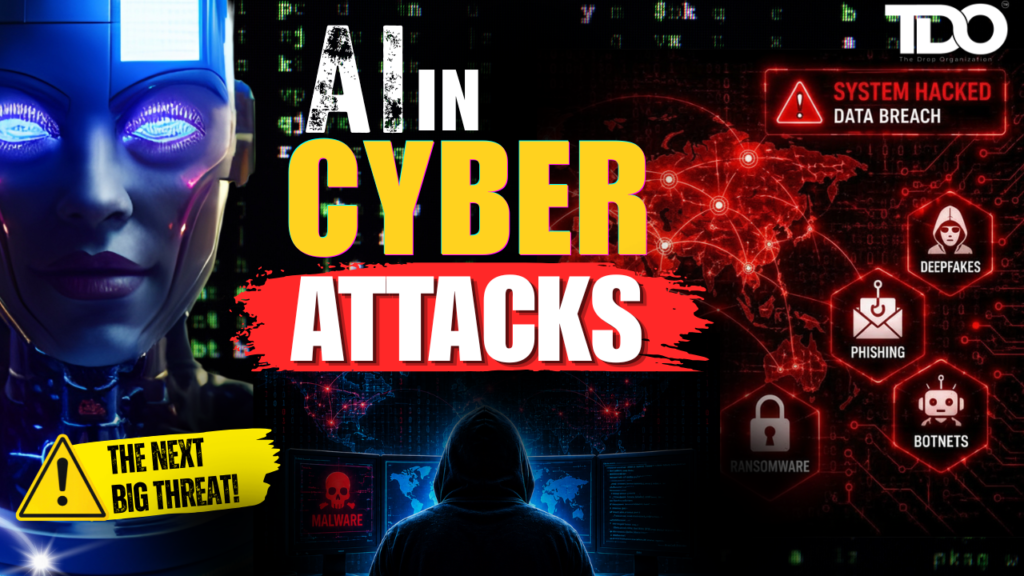
Learn how AI in cyber attacks is changing the cybersecurity landscape. Discover AI powered phishing attacks, deep fakes, adaptive malware and the best ways to defend yourself from AI powered cyber threats.
Artificial Intelligence (AI) is one of the most revolutionary technologies of the 21st century. AI is transforming industries like healthcare, finance, education, and entertainment through automation of processes, analysis of vast data, and improved decision-making. Businesses around the world are using AI to increase productivity, cut costs and develop new solutions. But like any powerful technology, AI has a dark side.
As organizations use AI to drive growth and efficiency, cybercriminals are increasingly using it to launch sophisticated cyber attacks. The emergence of AI in cyber attacks has significantly transformed the cybersecurity landscape, posing new challenges for businesses, governments and individuals alike. Classic cyber threats were highly dependent on human labor and manual execution.
AI in cyber attacks now allows hackers to automate malicious activities, adapt to security defenses, and create highly targeted attacks on an unprecedented scale. From AI-generated phishing emails to deepfake scams to adaptive malware, cybercrime is getting smarter and more dangerous. The rise in the use of AI in cybercrime has raised concerns among cybersecurity professionals around the world. As AI technologies continue to evolve, it is important to understand how AI works in cyber attacks to protect digital systems and sensitive information.
In this comprehensive guide, we will explore how hackers are using artificial intelligence, examine real-world examples, discuss emerging threats, and learn how organizations can defend themselves against the next generation of cyber attacks.
Also Read:- Social Media Hacks Exposed: 7 Powerful Safety Tips to Protect Your Digital Life
What is Artificial Intelligence in Cyber Attacks?
Artificial Intelligence (AI) is the ability of computer systems to perform tasks that normally require human intelligence, such as learning, reasoning, decision-making, and pattern recognition. When AI is included in the attack strategies of cybercriminals, they have several benefits such as more rapid automation, better targeting, adaptive conduct, improved evasion tactics as well as execution of massive attack.
The use of AI in cyber attacks is increasing and hackers are now able to carry out operations that were previously difficult, time-consuming, or impossible. AI-powered tools can analyse huge amounts of data, find vulnerabilities and launch attacks automatically. Unlike traditional cyber threats, AI used in cyber attacks is constantly learning and evolving, making it much harder for traditional security systems to detect.
Why Are Cybercriminals Using AI?
Hackers are always trying to work smarter, not harder. Artificial intelligence offers exactly that. Here are some of the main reasons why cybercriminals are adopting AI:
- Automation of scales- AI can be used to automate repetitive tasks like vulnerability scanning, phishing campaigns, and password cracking.
- Improved Accuracy- Machine learning algorithms learn user behavior to launch highly targeted attacks.
- More Rapid Exploitation- AI can find weaknesses and exploit them in seconds.
- Better Avoidance- AI malware learns and evolves to avoid detection by antivirus and firewalls.
Cyber crime is becoming more scalable and effective than ever with the increasing use of AI in cyber attacks.
1. Phishing Attacks Powered by AI: Smarter Than Ever
Phishing is one of the most dangerous applications of AI in cyber attacks. Phishing emails used to be rife with grammatical errors and suspicious wording. AI-driven phishing attacks today generate very convincing messages that look like human communication.
How Phishing Attacks Are Powered by AI?
Hackers use machine learning algorithms to:
- Analyze profiles on social media
- Study communication customs
- Collect personal details
- Send personalized emails
- Mimic writing styles
AI phishing attacks are very convincing and are able to bypass existing security filters easily.
Real-World Example
Imagine an email from your boss that refers to a recent meeting and requests an urgent document. The email seems real because AI checked public information and communication patterns before writing the messages. This demonstrates how much AI in cyber attacks increases the success rate of phishing.
2. Social Engineering and Deepfake Technology
Deepfakes are another alarming application of AI in cyber attacks. Deepfake technology uses artificial intelligence to produce lifelike audio, video and images that mimic real people.
Why Are Deepfakes A Threat?
Deepfakes can be used to:
- Financial fraud Identity theft
- Industrial espionage
- Disinformation efforts
- Attacks of social engineering
Imagine that you get a video call from your CEO asking you to wire money immediately — except the person on the screen is 100% AI-generated.
Real-World Example
Cybercriminals have already used AI-generated voice cloning technology to impersonate executives and sign off on millions of dollars of fraudulent financial transactions. Deepfakes and AI are being used in cyber attacks making it harder and harder to verify identity.
3. AI-powered Malware and Ransomware
Adaptive malware is one of the most advanced applications of AI in cyber attacks. Traditional malware uses static instructions. Malware based on AI learns from its surroundings and changes its behavior accordingly.
Capabilities of AI-Driven Malware
- Detect security systems
- Avoid antivirus software
- Adapt attack strategies
- Identify valuable files
- Target critical infrastructure
Ransomware powered by AI can learn the behavior of the network and figure out which files, when encrypted, will create maximum disruption. This evolution in AI in cyber attacks increases both the effectiveness and profitability of ransomware operations.
4. Automated Vulnerability Scanning and Exploitation
Finding system vulnerabilities traditionally required significant expertise and manual effort. Now, AI in cyber attacks does all this by itself. AI tools may be able to:
- Scan thousands of networks at once
- Discover outdated software
- Find weak passwords
- Scan for open ports
- Launch automated exploits
Cyber risk has grown exponentially since hackers can now attack multiple organizations simultaneously.
5. AI-Enhanced Evasion Techniques
Cybersecurity systems rely heavily on detecting known attack patterns. But AI in cyber attacks allows the malicious software to evolve continuously.
AI-based Evasion Strategies
- Code mutation
- Behavior modification
- Traffic obfuscation
- Dynamic payload generation
AI can watch firewalls and intrusion detection systems working and then change attacks so they don’t trip alarms. Consequently, traditional security tools are not capable of identifying these sophisticated threats.
The Future of AI Powered Cyber Attacks
The future of AI in cyber attacks will probably involve:
- Autonomous hacking systems
- AI-made malware ecosystems
- Sophisticated deepfake campaigns
- Smart botnets
- Ransomware that learns by itself
As AI technology becomes more available, cybercriminals may have access to more sophisticated tools to launch attacks. Organizations need to start preparing now to defend against these evolving threats.
How Organizations Can Protect Themselves From AI-Powered Threats?
Defending against AI in cyber attacks requires a proactive cybersecurity strategy.
1. Leverage AI-Powered Defense Systems
Organizations should use AI-enabled cybersecurity solutions that can detect anomaly, observe behavior, and respond automatically along with spotting suspicious patterns.
2. Improve Email Security
Advanced email filters can identify phishing attacks, phony domains, attachments that are suspicious and harmful links too. These systems help to lower the risk of AI-driven phishing attacks.
3. Cybersecurity Training for Employees
Human error is still a big weakness. Training for employees should include awareness towards phishing email, deepfake detection, safe surfing habits & knowledge of social engineering.
4. Enable Multi-Factor Authentication (MFA)
MFA provides an extra layer of security, protecting against unauthorized access even if stolen credentials are in play.
5. Frequent Security Audits
Organizations should do the following:
- Patch vulnerabilities
- Update software
- Do penetration testing
- Check security policies on regular basis
6. Platforms for Threat Intelligence
AI-driven threat intelligence tools provide real-time insights into emerging cyber threats and attacker behaviors.
The Role of Ethical Hackers in Fighting AI Threats
Ethical hackers are an important part of the defense against AI in cyber attacks. They simulate real world attacks with the aim of finding weaknesses, test security measures, improve response to incidents & enhance cybersecurity posture. To stay ahead of AI-powered cybercriminals, organizations are increasingly turning to ethical hackers.
The Drop Organization (TDO) provides cybersecurity education that prepares learners with real-world skills in ethical hacking, penetration testing, and cyber defense to combat emerging threats in the age of AI.
Final Thoughts
Artificial intelligence is transforming both cyber security and cyber crime. AI offers many opportunities for innovation, but when used by cybercriminals, it creates new and dangerous threats.
From tech-enabled scams and deepfake schemes to adaptive malware, automated exploitation and beyond, the digital threat landscape has evolved exponentially with AI being used in cyber attacks. Organizations must remain vigilant by leveraging advanced security technologies, training their staff, and continuously evolving their cybersecurity strategies. The future of cybersecurity will not only depend on technology but on our ability to understand and defend against the increasing use of AI in cyber attacks.
One thing is certain: The evolution of AI has ushered the war between cyber defenders and cybercriminals into a new era.
For More Such Content, Follow Us On:
Want to start your learning journey on Cyber Security and Ethical Hacking field?
