
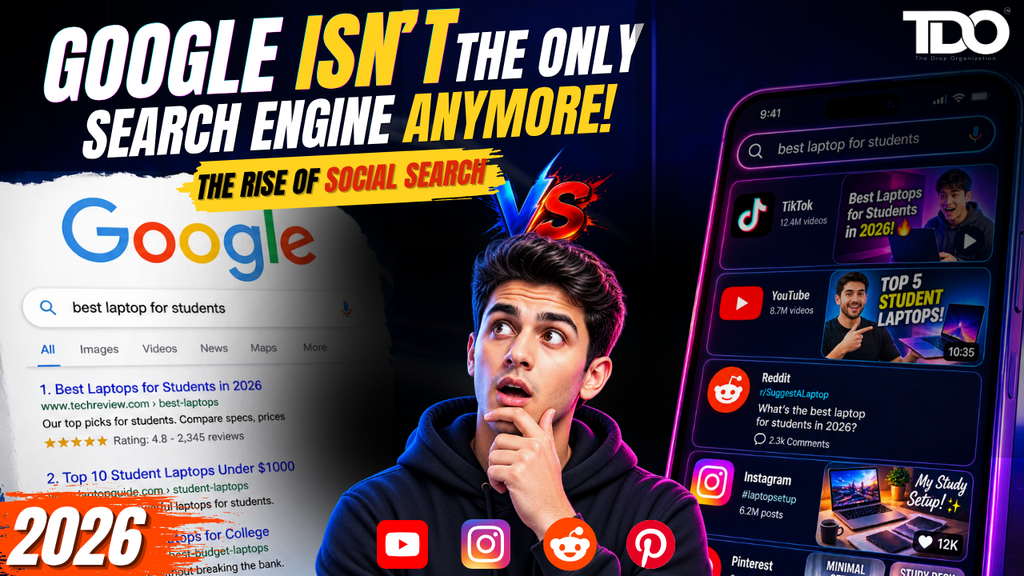
Discover how social search is changing online discovery as users turn to TikTok, Instagram, YouTube, Reddit and other platforms for recommendations, reviews, tutorials and answers—and learn how businesses can adapt their SEO strategy in 2026.
For years, if you wanted an answer, there was one obvious place to go. You opened Google. You asked your question. You clicked on some links. And you got what you wanted.
That habit became so deeply embedded in our daily lives that “Google it” practically became a synonym for “search for it online.” But now something interesting is going on. The way people are finding information is moving away from traditional search engines and into the many platforms they are already using every day.
Looking for a restaurant? You might go on Instagram or Tik Tok. Wondering if a product is actually worth buying? You might watch a few YouTube reviews.
Looking for honest opinions on a software tool? You should probably go to Reddit first. Interested in learning to edit a video, style an outfit, fix something, cook a recipe, or understand a complicated concept? A short form video can answer your question faster than a social search result page.
And that’s the essence of social search. And it is becoming more and more important for anyone working in SEO, content marketing, branding or digital marketing. This shift doesn’t mean Google has disappeared overnight. No, not at all. Google continues to evolve aggressively, including its AI-driven Search experience. Google said its AI Mode had surpassed 1 billion monthly users in May 2026, while Search queries reached an all-time high in the previous quarter.
So the real story is not Google versus social media search. It’s about something a lot more interesting: People are learning to search everywhere.
Also Read:- 5 Powerful Cybersecurity Careers You Didn’t Know Existed in 2026
What is Social Search?
Consider the idea in simple terms. Social search is the act of using social media and community-based sites to find information, recommendations, products, services, people, ideas and answers. Rather than exiting an app and launching Google, users are more and more searching directly inside platforms like Instagram, TikTok, YouTube, Reddit, Pinterest, Facebook, LinkedIn, X and other online niche communities. This is also frequently called social media search or social media SEO.
The main distinction is that users aren’t necessarily looking for the same sort of information they might get from a traditional Google search. Google is always good for questions like: “Digital marketing definition” But a person might go on Instagram and search: “Best course for digital marketing for beginners.” They might look up on YouTube: “How to create a digital marketing portfolio” They could ask on Reddit: “Should I learn digital marketing?
The question is tweaked a bit. And the kind of answer, more importantly, changes too. In a normal search result you get an article. On a social media search you might have a person explaining their experience, a demonstration, a review, a tutorial or a conversation between real users. That human element is one of the biggest reasons why social search is getting attention.
Statista defines social search as the search for information on user-generated-content platforms like Facebook, Instagram, Pinterest, TikTok, X, YouTube and others. Its research also shows that younger, tech-savvy generations are particular users of this behavior.
Why Do People Search On Social Media?
Imagine you’re trying to find a new restaurant. You could Google: “Best restaurants around me.” You will likely receive websites, maps, reviews, directories and ads. Or, you could pull up Instagram, look for the name of the restaurant. There are real food photos, interior videos, customer posts, reels, tips and comments from creators. The difference is subtle but significant. You’re no longer looking for information. You want experience. That is where social search has an advantage.
People want to see what it looks like, hear someone’s thoughts on it, and get a sense of how it works in the real world. This is particularly important for product recommendations, restaurants and travel, beauty and fashion, fitness, technology, education, tutorials, entertainment, career advice, local businesses, & reviews. This has therefore created an environment in which social media search can be a complement, rather than a replacement, to traditional SEO.
Google Search vs. Social Search: What’s Actually Different?
This is an easy thing to make a battle of. Google vs. Social Search. Traditional SEO versus social media SEO. But that is too simplistic. Both experiences tend to satisfy different kinds of search intent.Traditional search engines are particularly useful when people want detailed information, official sources, news, research, websites, documentation, comparisons, long-form guides, and specific services. Whereas social media search platforms are particularly attractive when people want personal experiences, visual demonstrations, reviews, recommendations, tutorials, trends, creator opinions, community discussions, inspiration or real-world examples.
The interesting thing is that the boundaries are increasingly blurring. Google itself is making social search more visual, conversational and multimodal. In 2026, Google announced a new Search experience that can work with text, images, files, videos and chrome tabs. AI Mode allows users to ask longer and complex questions.
At the same time, social media search platforms are getting better at understanding keywords, captions, videos, creators, topics and user intent. So the future of search is likely not one platform replacing another. It is more likely to be several discovery engines working together.
Instagram Is Turning Into a Visual Search Engine
There’s a slightly different opportunity on Instagram. It is strong in visual discovery. Someone who is interested in: “Cybersecurity career ideas.” They could find an article through a regular Google search. They may find, by searching Instagram reels, career guides, expert accounts, carousel posts, educational creators, comments and discussions.
This offers an important opportunity for brands. Your Instagram profile is no longer just a gallery of posts. It can turn into a searchable content library. This means that marketers need to be conscious of language used in captions, profile descriptions, on-screen text, hashtags, spoken content and post topics. This is where social SEO comes in. Instead of creating a post purely because it looks attractive, you can ask: “What would someone type into Instagram to find this?”
One question can dramatically change the way you create content.
YouTube: The Search Engine Inside Social Media
Where Instagram is great for quick discovery, YouTube is particularly good for deep learning. For years, people have been using YouTube as a social search destination. Think of how many times someone has looked: “How to fix…” “How to learn…” “Best…” “Review…” “Tutorial…”
YouTube videos can answer these queries and at the same time show the solution. This is what makes YouTube especially valuable for social search because it sits somewhere between a traditional search engine, a video platform, and a massive library of knowledge.
For marketers, this means video titles, descriptions, spoken words, chapters, thumbnails and audience engagement all become part of the discoverability equation. A beautifully produced video that nobody can find has limited value. A video optimized with the language people are actually searching for is much more likely to be found.
Reddit and The Power of Community Search
And now maybe one of the most interesting examples. Reddit. Someone might Google: “Best laptop for cybersecurity students.” But they may also search Reddit for: “What laptop are cybersecurity students actually using?” That difference matters. The first question asks for information. The second asks about community experience. Reddit is powerful because people usually talk about the practical side of decisions. They share personal experiences, mistakes, recommendations, warnings, comparisons, opinions, alternatives
For certain topics this kind of community knowledge can feel more useful than a well done marketing page. That’s why social search is not simply about algorithms. And it’s about trust, too. People want to know what other people actually experienced.
Why Social Search Is Important for Digital Marketers?
Now imagine you own a business. For years, your digital strategy may have looked something like this:
Website → Google SEO → Blog → Search traffic → Conversion
That strategy is still valuable. But now there may be another path:
TikTok → Discovery → Instagram → Profile → Website → Conversion
Or: YouTube → Tutorial → Search → Website → Conversion
Or: Reddit → Community discussion → Brand discovery → Website
The customer journey is becoming increasingly fragmented. This means digital marketers cannot afford to think about search as something that happens only on Google. Social media search is an added layer of discovery. And it changes content strategy. Instead of creating one blog post and sharing it one time, brands can repurpose the same idea into:
- A blog article
- A YouTube video
- An Instagram carousel
- A Reel
- A TikTok
- A LinkedIn post
- A Reddit discussion
- A Pinterest graphic
One idea can therefore become an entire social search ecosystem.
What Is Social SEO?
If social search is the act, social SEO is the process of making your content findable in social media. Traditional SEO focuses a lot on things like relevance, content quality, technical accessibility, links and search intent. Social SEO includes elements unique to each platform. For example, marketers may need to consider keywords in captions, search-friendly titles, on-screen text, spoken keywords, hashtags, profile optimization, engagement, watch time, saves, shares, comments, content relevance.
On each platform the ranking systems are different and marketers should not assume that one platform works like another. However, the principle is simple: Create content around what people are already searching for.
Sprout Social similarly recommends a social-first approach to search by optimizing profiles and content with keywords and hashtags that are relevant, and by employing social listening to uncover the questions and conversations taking place around a brand.
How to Optimize Your Content for Social Search?
So how do you really capitalize on this trend? You don’t have to throw out your current SEO strategy. Instead, build another layer on top of it.
1. Focus on Search Intent
Before you make a reel, video, carousel, or article, ask yourself what the user really wants. Are they attempting to learn? Compare? Buy? Find a recommendation? Solve a problem? Be entertained? Find out what they want before you choose your format.
2. Use Words People Use to Search
This seems obvious, but many businesses make the mistake of using clever language instead of searchable language. Let’s say you write a post about cybersecurity for beginners. Rather than write: “Unlock Your Digital Potential.” You could use: “5 Cybersecurity Skills Every Beginner Should Learn.”
The second version tells the audience and the platform what the content is about. This is one of the most basic pillars of social media SEO.
3. Add the Topic to Your Video
Don’t hide your topic. If your video is about: “How to Start a Cybersecurity Career” say it. Put it on the screen. Just put it in the introduction naturally. Use it in the caption. This is not keyword stuffing. Context is the goal. The goal is context. You want the platform to understand what your content is about and match it with users looking for that subject.
4. Optimize Your Social Profiles
Your profile itself can become a search result. Make it immediately clear:
- Who are you?
- What do you offer?
- Who will you help?
- What subjects do you cover?
If you’re a digital marketing trainer, for example, don’t make your profile description so vague that nobody understands what you do. Make your expertise discoverable. This is particularly important as social search continues to influence how people discover creators and brands.
Social Search Is Changing Keyword Research
Traditional keyword research often begins with tools designed around Google. You enter a keyword. You examine the search volume. You study competition. You identify related terms. You create content. That process is still valuable. But social media search adds another source of research—the platforms themselves.
Open up Instagram. Begin typing a subject. See autocomplete suggestions. Do the same on YouTube. Discover Instagram search. Check out Reddit threads. Read the questions people post in the comments. And then you unlock another level of audience intelligence. It can reveal language that traditional keyword tools might not catch. For instance, your SEO tool might tell you that people search for: “digital marketing course.” But TikTok comments might reveal that users are actually asking: “Is digital marketing worth learning after graduation?”
That’s an opportunity for different content. And sometimes it’s those conversational questions that drive content.
User Content Created Is Increasingly Valuable
The biggest advantage of social search is that it places real people at the center of discovery.
Consider research on products. Would you rather read ten paragraphs from a brand about how good its product is? Or watch three customers actually show you how they use it? That’s the power of content created by users.
Examples of social proof that are hard to duplicate in traditional advertising are reviews, testimonials, tutorials, customer videos, Reddit conversations and creator stories. The takeaway for brands? It’s simple: “Do not just talk about your product. Give people a reason to talk about it”.
What Does This Mean for Traditional SEO?
Here’s the part most marketers are getting wrong. Social search is on the rise, but that doesn’t mean SEO is dead.
SEO isn’t dead. Google isn’t going anywhere. Websites aren’t going away. Blogs aren’t going away. Instead, there is growing search. And Google itself is also pouring a ton of money into AI-powered discovery. Its 2026 Search updates focus on deeper exploration, original content, direct links and first-hand perspectives. Even traditional search is shifting to richer discovery experiences. Hence the more intelligent approach is not: SEO OR social media. It is: SEO + social search + content distribution + community.
You can rank your blog on Google. Your video can be ranked on YouTube. Your reel may show up in Instagram search. You can search the platform for Instagram. Your Reddit discussions can appear in both community searches and traditional search results. One piece of expertise can therefore create multiple discovery opportunities.
How Businesses Can Prepare for the Social Search Era?
As a business owner or marketer, this shift should affect your content strategy. Next, identify the questions your customers are asking over and over again. Then create content in various formats to answer those questions. Say you run a cybersecurity training company, for example. A typical question might be: “How do I start a career in ethical hacking?”
You could turn that single question into: a detailed blog, a YouTube tutorial, an Instagram carousel or video, a LinkedIn post, a short FAQ, a Reddit discussion or an infographic. Now you are not tied to one search channel. You build a network of searchable content. That’s the real power of social search.
The Drop Organization and the New Search Space
The evolving nature of discovery is especially significant for the education of digital marketing.
At The Drop Organization (TDO), digital marketing training includes areas such as SEO, social media marketing, Meta Ads, content marketing, website design, portfolio building and LinkedIn optimization through its DCMC — Drop Certified Marketing Course.
Explore The Drop Organization’s Digital Marketing Course
This combination is more important than ever, as modern digital marketing is no longer about just mastering one platform. A marketer may want to know how someone finds a brand on Google, watches its video on YouTube, checks its Instagram profile, reads reviews on Reddit, and then goes to its website.
SEO and Social Media Marketing are specifically incorporated into the DCMC curriculum and the relationship between traditional search and social search is an important part of the modern digital marketing conversation. That’s when social search becomes more than a passing fad. It’s part of understanding how people find information.
The digital marketing material produced at TDO is not about theory but about practical implementation, hands-on projects and real-world application. That practical mindset matters for aspiring digital marketers, because algorithms will change. The basics – knowing your audiences, search intent, useful content, analytics and distribution – are what remain valuable.
The Future of Social Search Won’t Have One Front Door
Remember the internet ten years ago? Often the search began with a browser. Today’s discovery can be made just about anywhere. Someone can watch a Reel. Search the creator.
See a video on YouTube. Check out Reddit. Ask ChatGPT.
Go to Google. Go to a brand’s website. Go back to Instagram. The journey is no longer a straight line. That’s why marketers need to start thinking about search environments, not the search engine. Google is one. YouTube is another. Instagram is another. Reddit is another. And AI-powered search is becoming another layer altogether. The user’s question determines where they go. That is the fundamental change.
Will Social Search Replace Google?
Probably not in the simple sense that headlines sometimes imply.
Google remains hugely important and its continued investment in AI Search shows it is adapting and not standing still. By 2026, Google announced AI Mode had crossed a billion monthly users, while overall Search queries reached record levels.
At the same time, social media search platforms have become important discovery environments for recommendations, visual information, tutorials, community opinions and creator-lead content. Statista’s category overview notes that social platforms are becoming increasingly powerful for information searches, especially among the younger generations.
So the more realistic future is: Google will remain important. Social search will continue to be relevant. AI search will be more and more important.
And users will flip back and forth between all three depending on what they want. It’s not the platform with the most users that will win. The winner is going to be the platform that provides the user with the right answer in the right format at the right time.
What Marketers Need To Do Now?
If you’re creating content today, don’t wait till social search becomes impossible to ignore. Begin experimenting now.
Create searchable content→ Post for your existing followers, but don’t stop there. Produce content that can be found by a search by a person who has never heard of you before
Real questions answered → Content ideas are in the questions your audience asks.
Use natural keywords → Don’t stuff captions with keywords. Use the language your audience actually uses.
Test video → Video is especially effective when people are searching for demos, explanations or reviews.
Smart reimagination → Instead of inventing entirely new ideas for each platform, take one good idea and adapt it into several formats.
Monitor your analytics → Look beyond the likes.
Track: Search-driven views, Saves, Shares, Profile visits, Website clicks, Watch time, Engagement & Conversions.
The objective isn’t just to go viral. It is to become discoverable.
The Biggest Mistake: Creating Content Only for Algorithms
There is irony in this. Marketers become obsessed with social SEO and forget about the people they’re trying to reach. Do not make that mistake. A great optimized post that nobody finds useful will do nothing for a brand. The best social content starts with a human problem. Somebody has a question. Somebody is confused. Someone needs a recommendation. Someone needs a tutorial. Someone wants to compare two products with each other. Someone is trying to make a decision.
Your job is to assist. The algorithm is merely a means of distribution. That mindset will be your content strategy’s shield against platform changes to ranking systems.
Final Thoughts: Search is not a place anymore- It’s a behavior
For years, we thought of search as a destination. We opened Google. We sent in a query. The results are out. But the internet is too interconnected for search to be limited to one place. People look for things in places where they already hang out. When they want to know things fast, they go to Instagram. They look for visual inspiration on Instagram. They look for demonstrations and tutorials on YouTube. And they want community experiences on Reddit. They Google websites, research, products and in-depth information. They are using AI tools to answer questions that are becoming more conversational and complex.
This is the real story of the rise of social search. It isn’t about Google suddenly becoming irrelevant. It’s about users being smarter about how they search for information. This is both a challenge and an opportunity for businesses and digital marketers.
If all your strategy is about ranking a website on Google you are visible, but only in one part of the modern discovery journey. The smarter way to do this is to build up a presence where your audience is actually searching. Write helpful posts. Make videos that are searchable. Answer the questions. Join communities. Optimize your profiles. Listen to what people are asking.
And above all: And most importantly, create content that deserves to be discovered. Because the future of social search is more than simply ranking higher. It’s about showing up where the conversation starts. And as social search grows, the brands that understand this early will have an important advantage. People don’t simply google things anymore. The search bar is everywhere.
What is social search?
Social search is the practice of using social media platforms such as Instagram, YouTube, Reddit and Pinterest to find information, recommendations, reviews, tutorials and answers. Instead of relying only on traditional search engines, users search directly within the platforms where they already consume content.
Is social search replacing Google?
Not exactly. Social search is expanding the way people discover information rather than simply replacing Google. Google remains extremely important, while social platforms are particularly useful for visual content, personal recommendations, tutorials and community experiences.
Why are people using Instagram as a search engine?
Instagram combines search with short-form video, which makes it particularly useful for discovering demonstrations, reviews, recommendations and quick explanations. Users can see real examples rather than simply reading traditional search results.
Is social search important for digital marketing?
Yes. As consumers use social platforms for research, recommendations and discovery, marketers have another opportunity to reach audiences beyond traditional search engines. A strong strategy can combine traditional SEO, social media marketing, video content and community engagement.
How can businesses optimize for social search?
Businesses should begin by understanding what their audience actually searches for on each platform. They can then create useful, searchable content using natural keywords in captions, titles, spoken content and on-screen text while maintaining strong relevance and quality.
The Search May Be Changing—But Your Learning Never Stops!
Want to start your learning journey on Cyber Security and Ethical Hacking field?
