
The Powerful Rise of Social Search: Why Google Isn’t the Only Search Engine Anymore in 2026
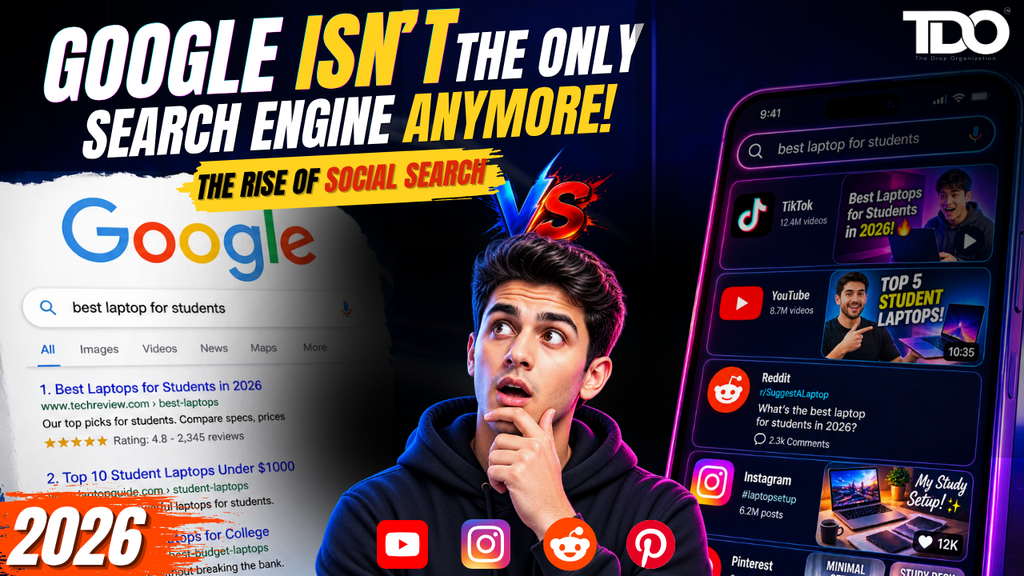
Discover how social search is changing online discovery as users turn to TikTok, Instagram, YouTube, Reddit and other platforms for recommendations, reviews, tutorials and answers—and learn how businesses can adapt their SEO strategy in 2026. For years, if you wanted an answer, there was one obvious place to go. You opened Google. You asked your question. You clicked on some links. And you got what you wanted. That habit became so deeply embedded in our daily lives that “Google it” practically became a synonym for “search for it online.” But now something interesting is going on. The way people are finding information is moving away from traditional search engines and into the many platforms they are already using every day. Looking for a restaurant? You might go on Instagram or Tik Tok. Wondering if a product is actually worth buying? You might watch a few YouTube reviews. Looking for honest opinions on a software tool? You should probably go to Reddit first. Interested in learning to edit a video, style an outfit, fix something, cook a recipe, or understand a complicated concept? A short form video can answer your question faster than a social search result page. And that’s the essence of social search. And it is becoming more and more important for anyone working in SEO, content marketing, branding or digital marketing. This shift doesn’t mean Google has disappeared overnight. No, not at all. Google continues to evolve aggressively, including its AI-driven Search experience. Google said its AI Mode had surpassed 1 billion monthly users in May 2026, while Search queries reached an all-time high in the previous quarter. So the real story is not Google versus social media search. It’s about something a lot more interesting: People are learning to search everywhere. Also Read:- 5 Powerful Cybersecurity Careers You Didn’t Know Existed in 2026 What is Social Search? Consider the idea in simple terms. Social search is the act of using social media and community-based sites to find information, recommendations, products, services, people, ideas and answers. Rather than exiting an app and launching Google, users are more and more searching directly inside platforms like Instagram, TikTok, YouTube, Reddit, Pinterest, Facebook, LinkedIn, X and other online niche communities. This is also frequently called social media search or social media SEO. The main distinction is that users aren’t necessarily looking for the same sort of information they might get from a traditional Google search. Google is always good for questions like: “Digital marketing definition” But a person might go on Instagram and search: “Best course for digital marketing for beginners.” They might look up on YouTube: “How to create a digital marketing portfolio” They could ask on Reddit: “Should I learn digital marketing? The question is tweaked a bit. And the kind of answer, more importantly, changes too. In a normal search result you get an article. On a social media search you might have a person explaining their experience, a demonstration, a review, a tutorial or a conversation between real users. That human element is one of the biggest reasons why social search is getting attention. Statista defines social search as the search for information on user-generated-content platforms like Facebook, Instagram, Pinterest, TikTok, X, YouTube and others. Its research also shows that younger, tech-savvy generations are particular users of this behavior. Why Do People Search On Social Media? Imagine you’re trying to find a new restaurant. You could Google: “Best restaurants around me.” You will likely receive websites, maps, reviews, directories and ads. Or, you could pull up Instagram, look for the name of the restaurant. There are real food photos, interior videos, customer posts, reels, tips and comments from creators. The difference is subtle but significant. You’re no longer looking for information. You want experience. That is where social search has an advantage. People want to see what it looks like, hear someone’s thoughts on it, and get a sense of how it works in the real world. This is particularly important for product recommendations, restaurants and travel, beauty and fashion, fitness, technology, education, tutorials, entertainment, career advice, local businesses, & reviews. This has therefore created an environment in which social media search can be a complement, rather than a replacement, to traditional SEO. Google Search vs. Social Search: What’s Actually Different? This is an easy thing to make a battle of. Google vs. Social Search. Traditional SEO versus social media SEO. But that is too simplistic. Both experiences tend to satisfy different kinds of search intent.Traditional search engines are particularly useful when people want detailed information, official sources, news, research, websites, documentation, comparisons, long-form guides, and specific services. Whereas social media search platforms are particularly attractive when people want personal experiences, visual demonstrations, reviews, recommendations, tutorials, trends, creator opinions, community discussions, inspiration or real-world examples. The interesting thing is that the boundaries are increasingly blurring. Google itself is making social search more visual, conversational and multimodal. In 2026, Google announced a new Search experience that can work with text, images, files, videos and chrome tabs. AI Mode allows users to ask longer and complex questions. At the same time, social media search platforms are getting better at understanding keywords, captions, videos, creators, topics and user intent. So the future of search is likely not one platform replacing another. It is more likely to be several discovery engines working together. Instagram Is Turning Into a Visual Search Engine There’s a slightly different opportunity on Instagram. It is strong in visual discovery. Someone who is interested in: “Cybersecurity career ideas.” They could find an article through a regular Google search. They may find, by searching Instagram reels, career guides, expert accounts, carousel posts, educational creators, comments and discussions. This offers an important opportunity for brands. Your Instagram profile is no longer just a gallery of posts. It can turn into a searchable content library. This means that marketers need to be conscious of language used in captions, profile descriptions, on-screen text, hashtags, spoken content and post topics. This