
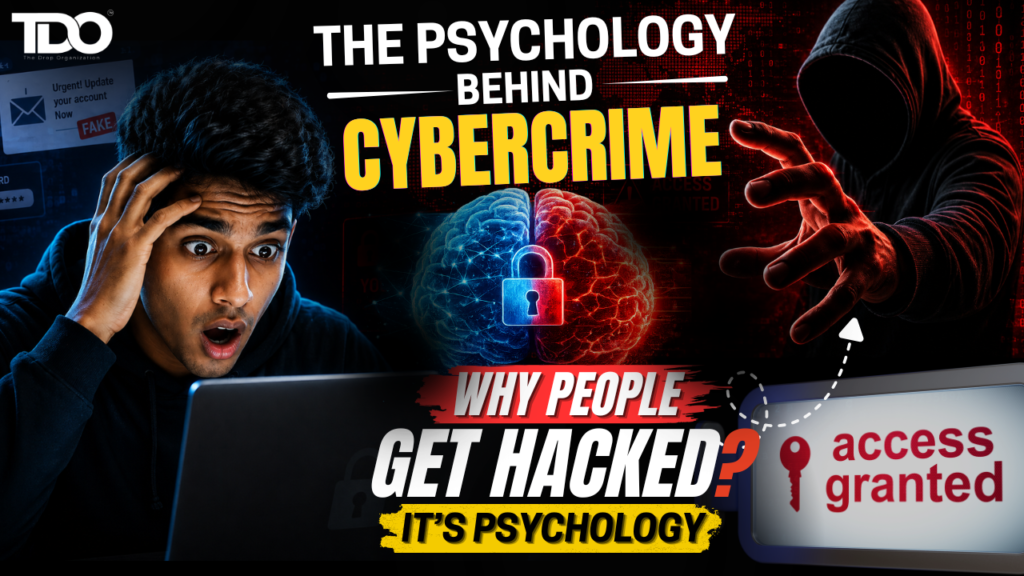
Discover the truth behind cybercrime psychology and learn why people become victims of cyber attacks. Explore the human side of hacking, common psychological tricks used by cybercriminals, and practical ways to stay protected.
Think of a phone call from your bank telling you that your account has been compromised. The voice on the phone is calm, professional and oddly convincing. You share an OTP to “secure” your account without thinking twice. A few minutes later your savings are washed away.
Now ask yourself one simple question. Was your phone hacked because it was too weak? Or were you hacked because somebody knew your mind better than your device? This is the point where the cybercrime psychology concept becomes very important.
When you hear the word hacker, you generally picture people sitting in dark rooms, surrounded by computer screens, typing complex code to break into secure systems. In the movies they’re portrayed as technical geniuses who can outsmart sophisticated security software.
Most successful cyber attacks don’t even start with computers. They start with understanding people. Computers don’t usually make emotional decisions and cyber criminals know that. Humans do.
That’s why modern cybercrime is as much psychology as technology. Attackers often attack firewalls after attacking fear, curiosity, trust, excitement, greed and urgency. They play on human emotions until the victims, unknowingly, allow them access. This secret science is called cybercrime psychology and knowing it can drastically cut down your chances of being the next victim.
In this blog, we will discuss why having a high IQ doesn’t prevent people from falling for online scams, how cybercriminals exploit human behavior, and why cybersecurity is no longer just about protecting computers, but protecting the human mind.
Also Read:- 7 Digital Marketing Myths You Should Stop Believing in 2026
What is Cybercrime Psychology?
Before we start with the question of how hackers manipulate people, let’s learn what the science of cybercrime psychology actually is. In simple terms, cybercrime psychology is the study of how cybercriminals exploit human thoughts, emotions, habits, and decision making to successfully carry out cyber attacks. Hackers know one important truth. It is difficult to get into a secure computer.
Convincing a person to open the door is often much easier. Attackers will spend minutes to craft convincing emails, fake websites or persuasive phone calls rather than spending weeks searching for software vulnerabilities. But in reality, they aren’t really after your computer. It’s your decision making.
Grasping the cybercrime psychology assists in understanding why people click on dubious links, download infected files, believe fake messages or give away confidential information without knowing the consequences.
That’s why cybersecurity experts often say, “Humans are the weakest link in cybersecurity.” Not because people are not smart. But because people naturally trust, respond emotionally and make snap decisions under pressure.
Why Cyber Criminals Attack People, Not Computers?
Technology is very advanced. The companies spend millions on firewalls, encryption, anti-virus software and intrusion detection systems. Banks have whole teams of cybersecurity experts. Big organizations do security audits on a regular basis. It’s not impossible to break through these defenses, but it takes work. Humans, however, are unpredictable. People are tired. People get sidetracked. People get curious. People panic. People trust authority.
Cybercriminals have a remarkable insight into these behaviors. This understanding underpins cybercrime psychology. Attackers often ask themselves a much simpler question instead of attacking complicated software:
“How can I convince someone to give me access willingly?”
This method saves time and increases the success rates. For example you might get an email that says something like this: ” Your email account will be deleted forever in 1 hour if you do not verify your password right now. ” Many people won’t bother to check the sender. Fear takes over instead. They clicked on the link. Enter their password. And unwittingly surrender their credentials. The computer had not been cracked. The person had been set up.
The Human Brain: The Biggest Security Weak Link
One of the most interesting things about cybercrime psychology is how our brains respond to emotion. Humans don’t make decisions based on pure logic. But emotions play a part in almost every important decision we make. These emotional shortcuts are carefully exploited by cybercriminals.
They create situations where victims cooperate willingly. They do not force victims to act. Here are some of the most common psychological triggers:
The Deadliest Weapon: Fear
One of the strongest human feelings has been fear. Cybercriminals know this very well. Now imagine getting this message: “Your bank account has been frozen.” Or, “The Income Tax Department has detected suspicious activity.” Or, “Your social media account will be permanently disabled today.”
Most people stop thinking rationally immediately. Instead they will solve the problem. The urgency causes mistakes. Victims click on malicious links. Download of fake applications. Show passwords. Share OTPs. The attack is successful because fear overrides logic. This emotional manipulation is one of the most obvious examples of cybercrime psychology at work.
Curiosity Makes People Click
Did you ever get messages saying:
“Who checked your profile?” “Private video leaked.” “Congrats! “You got a new phone.
See what someone said about you.”
The purpose of these messages is one. To spark curiosity. Curious, it is natural. Humans are always searching for new information. Cybercriminals know this all too well. When curiosity starts, many people ignore warning signs.
They click on links they don’t know. Download files that seem suspicious. Install bogus apps. Sometimes mere curiosity is sufficient to bring down a whole system. That’s why cyber security experts keep telling people to verify information before clicking on anything online.
We can understand cybercrime psychology to know that it is not always technical hacking that hackers do. Sometimes they count only on human curiosity.
Trust: The Door Hackers Walk Through Invisibly
Trust is what makes society work. We believe in our banks. We depend on our employers. We depend on delivery companies. We trust friends. Unfortunately, cyber criminals take advantage of this behavior.
Imagine getting an email that looks like it’s from your college administration asking students to verify their accounts. The email contains official logos.Professional language. Correct formatting. It all feels real. The message seems familiar, so many students trust it right away. This technique is known as impersonation.
Attackers do this by masquerading as an organization that a person already trusts, rather than creating a completely fake identity. The more trust, the higher the chances for success. It is this relationship between trust and deception that is central to cybercrime psychology.
Bad Decisions Are Forced by Urgency
Remember when the last person said to you, “Offer expires in five minutes.” Did you feel pressured? Cybercriminals intentionally create urgency because they know people make poor decisions under time pressure. Examples include:
- “Update your password immediately.”
- “Your package delivery failed.”
- “Claim your reward now.”
- “Limited-time investment opportunity.”
- “Account suspension within one hour.”
Spot a pattern? Every message steals time for careful thinking. Victims react, they don’t analyze. Cybercriminals don’t want you to use your brain. They want you to react emotionally. This is exactly how cybercrime psychology affects human behaviour.
Why Smart People Still Become Victims?
One of the biggest myths is that only inexperienced internet users get hacked. Nothing could be further from the truth. Be it doctors, engineers, companies, professors, IT professionals, even the best cyber security experts have been caught off guard by well-planned attacks. Why?
Because intelligence doesn’t eliminate emotion. People, when stressed, distracted, excited, overwhelmed, can miss warning signs.
Cybercriminals don’t necessarily target less intelligent victims. They search for opportunities to be vulnerable. That is the real strength of cybercrime psychology. It doesn’t matter how intelligent you are. It depends on how you feel at a particular moment.
Social Engineering: The Art of Human Hacking
If there is a practical use of cybercrime psychology, it is social engineering for sure. Social engineering is distinct from traditional hacking, such as cracking passwords or exploiting software vulnerabilities. Instead, it’s about persuading people to give up information, download malicious software or give access willingly.
Social engineering can be seen as communication in disguise or psychological manipulation. The attacker studies human behavior before the attack. They watch how people react under pressure, how much faith people put in authority, and how readily they can be swayed by inducements or threats.
For instance, a student could receive an email claiming to be from the college administration, asking the student to verify their login credentials, as the student portal is being upgraded. Everything about the email looks authentic—the logo, the language, even the email signature.
The student types in their username and password, thinking nothing of it. The attacker didn’t hack the college portal. They just knew enough about cybercrime psychology to get the student to give up the credentials willingly. That is why cybersecurity experts often say that social engineering is one of the most dangerous types of cybercrime.
Greed: When Free Costs You Dear
Everyone loves getting something valuable for nothing. And hackers know that. They often spread quickly as they appeal to the greed of human nature and promise free smartphones, laptops, gaming vouchers, cryptocurrency rewards or expensive software. Now let’s say you get a message like:
“Congratulations! Congratulations! You’ve been chosen to get a free laptop. Click here to redeem. ”
Many of them immediately get excited. They don’t stop to question the legitimacy of the offer. They only see the reward. Excitement makes people think less critically, and cyber criminals know this. This simple emotional reaction is another important part of cybercrime psychology. The message is simple: If it sounds too good to be true it usually is.
Authority: Why We Obey Without Question
We have been taught to trust teachers, parents, the police, government departments and company managers since we were children. This natural respect of authority keeps order in society. Unfortunately, it is exploited by cybercriminals.
Suppose you receive an email that looks like it is coming from your company’s HR department, asking you to change your password immediately. Or a phone call purporting to be from your bank’s fraud investigation unit. Most people are afraid to challenge authority. Instead, they comply. Cybercriminals are well aware of this psychological behavior. They manufacture fake identities that seem strong, official, and trustworthy.
Once the victim believes that the authority is real, it is much easier to obtain his cooperation. Again, this suggests that the psychology of cybercrime is more concerned with manipulating human behaviour than with overcoming sophisticated technology.
Sympathy Can Be Taken Advantage Of Too
Not all cyberattacks are fear-based. Some depend on kindness. Imagine getting a fundraising message about a child needing emergency surgery or victims of a natural disaster. Many people give right away because they really want to help. There are a lot of legitimate charities, but cyber criminals also set up fake donation campaigns during disasters, wars or humanitarian crises.
They feed off of empathy. This reminds us about the diversity of cybercrime psychology. Attackers know about positive and negative emotions and will use whichever emotion is most likely to influence their victims. It is important to help others. Just as important is to check out before you donate.
How Does The Mind Of An Ethical Hacker Think Differently?
To me, one of the most interesting things about cybersecurity is how ethical hackers are studying cybercrime psychology for defensive purposes. They don’t prey on human weaknesses, they spot them before criminals do.
Ethical hackers ask questions such as:
- Would employees trust this phishing email?
- Can students recognize fake login pages?
- Are users sharing sensitive information publicly?
- Which psychological tricks are most likely to succeed?
Understanding the mindset of the attacker allows ethical hackers to increase awareness, improve security policies, and reduce human error. That’s why cybersecurity education today is not only about technology, but about understanding human behavior. Knowing how the attacker thinks puts the defender that one step ahead advantage.
Simple Habits To Keep You Safe
The good news is you don’t always need to be an expert in technology to protect yourself. Developing the right habits can dramatically reduce your risk. Some of the most effective practices include:
- Think before clicking unfamiliar links.
- Verify email senders carefully.
- Never share OTPs or passwords.
- Use Multi-Factor Authentication (MFA).
- Keep software and devices updated.
- Create strong, unique passwords.
- Avoid downloading files from unknown sources.
- Verify urgent requests through official channels.
- Stay informed about new cyber threats.
These simple habits strengthen both your technical security and your awareness of cybercrime psychology.
Awareness of Cybersecurity: As Critical as Ever
Technology will continue improving. Artificial Intelligence will get smarter. Security software will become more sophisticated. But one challenge will stay the same. Human behavior. No antivirus can ever fully protect the person who knowingly shares passwords with attackers. No firewall can stop a victim from sending money to a scammer after being emotionally manipulated. That’s why cybersecurity awareness has become one of the most valuable skills in the digital world today. Understanding cybercrime psychology helps people identify emotional manipulation before they react rashly. Awareness turns regular internet users into informed digital citizens.
Learning Cybersecurity Beyond Theory
A lot of people think that cybersecurity is only for programmers or IT professionals. That is miles away from reality. Every student, entrepreneur, employee and internet user needs to be aware of cybersecurity.
Learning about phishing, malware, ethical hacking, digital privacy and cybercrime psychology is important to protect yourself and those around you. That’s why cybersecurity education has become more practical. Students aren’t just learning software anymore.
They learn about people. Because ultimately cybersecurity is as much about protecting human decisions as it is about protecting computer systems.
How TDO Helps Students Understand Modern Cybersecurity?
The cyber landscape is changing fast and needs more than theoretical knowledge. Students need practical exposure to understand the technical and psychological aspects of cyber attacks. Here, TDO seeks to bridge the gap between education & real-world cybersecurity.
The Drop Certified Security Course (DCSC) and The Hack Track (THT) provide exposure to the learners on practical cybersecurity concepts, ethical hacking methodologies, digital safety practices, vulnerability assessment, network security, and cybersecurity awareness.
More importantly, students also learn about cybercrime psychology – how attackers think, how social engineering works and why human behaviour often determines whether an attack is successful or unsuccessful.
TDO emphasizes the importance of responsible cybersecurity professionals who are able to protect individuals, organizations, and digital communities, rather than just focusing on hacking techniques.
Final Thoughts
Cybercriminals are constantly evolving their methods. But they are not looking only at technology. They study human beings. Every phishing email, fake website, fraudulent phone call, and online scam is carefully crafted around human emotion. Fear, faith, interest, greed, power, compassion, understanding, such emotions are the foundation of cybercrime psychology, and therefore one of the most important concepts that every Internet user must understand.
The good news is that awareness makes all the difference. Knowing psychological manipulation allows you to stop reacting emotionally and start thinking critically. A moment of awareness can prevent identity theft, financial fraud, data breaches and myriad other cyber attacks.
If you’re a student just starting out in cybersecurity—or if you’re just someone who uses the internet every single day—you can no longer afford to ignore cybercrime psychology. In the digital world today, the strongest security system is not only your antivirus.
It’s the ability to see manipulation before it becomes a cyber attack.
Think Before You Click. Learn Before You Trust. Stay Secure.
Want to start your learning journey on Cyber Security and Ethical Hacking field?
